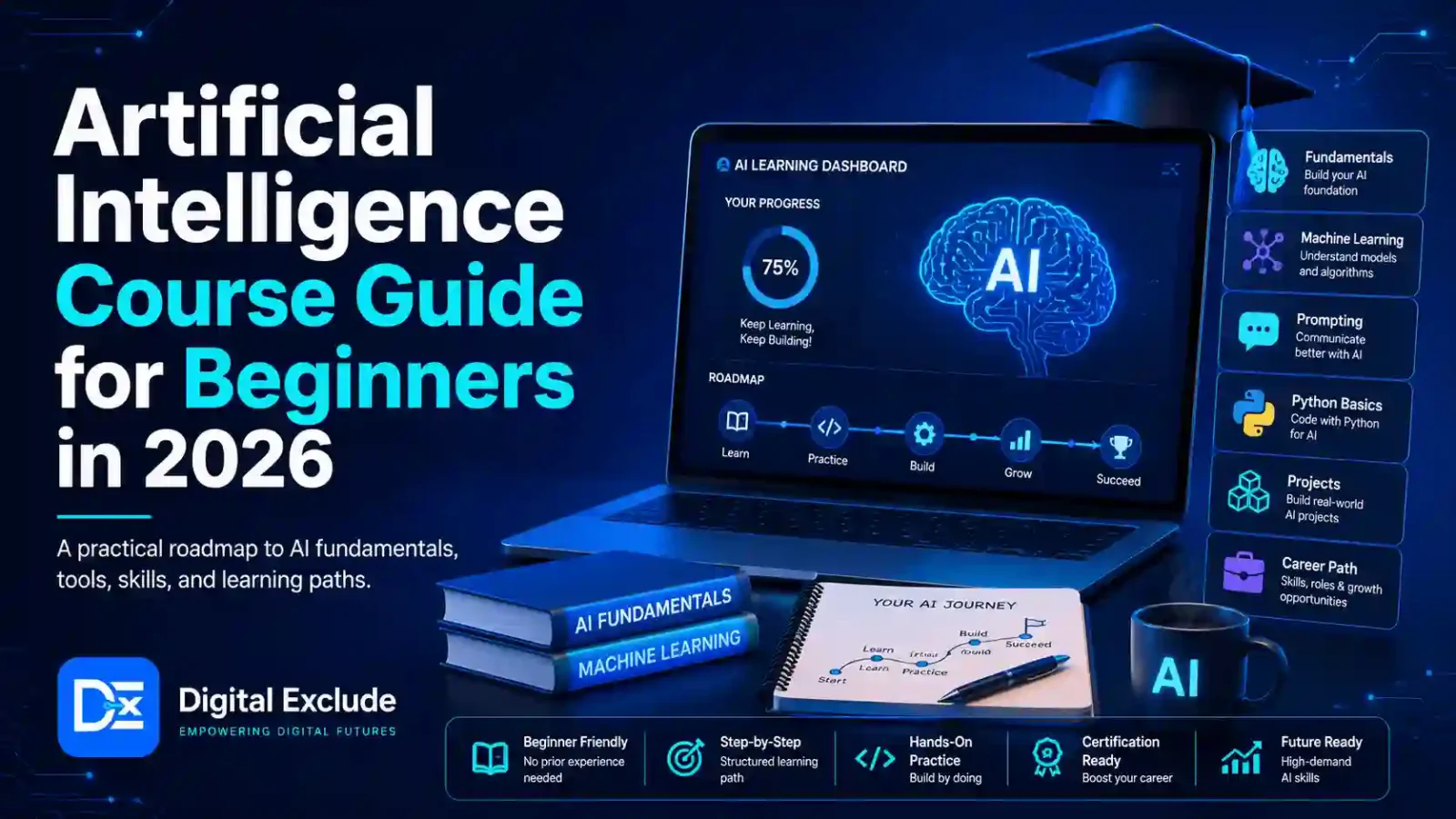
Artificial intelligence is now part of daily work, not just software engineering or research. Students use AI for study support, marketers use it for planning, founders use it for automation, developers use it for coding support, and business teams use it for faster decision-making. That is why choosing the right Artificial Intelligence Course in 2026 matters.
The difficult part is not finding an AI course. The difficult part is choosing one that fits your goal. Some courses teach workplace AI skills. Some focus on cloud AI certification. Some are built for non-technical learners. Others expect you to learn Python, machine learning, and AI app development.
This guide is written for beginners, students, working professionals, career switchers, freelancers, solo founders, and IT learners who want a practical way to compare AI courses before spending time or money.
Quick Answer
The right Artificial Intelligence Course depends on your career goal. Choose Google AI Essentials for workplace AI skills, AI For Everyone for non-technical AI understanding, IBM AI Foundations for practical no-code exposure, Microsoft Azure AI Fundamentals or AWS Certified AI Practitioner for cloud AI certification, IBM AI Developer for AI app building, and Machine Learning Specialization for a stronger technical foundation.
Who This Guide Is For
This guide is useful for:
- Students exploring AI as a career path
- Beginners who want an AI course for beginners
- Working professionals who want AI skills for current roles
- Non-technical professionals in marketing, HR, sales, finance, operations, or content
- Developers who want to build AI-powered applications
- IT learners comparing cloud AI certifications
- Freelancers who want to use AI for client work
- Career switchers comparing free, paid, short, and structured options
- Learners in India, the USA, and other global markets
How We Selected These Courses and Certifications
- Provider Credibility: We included recognized providers such as Google, IBM, Microsoft, AWS, DeepLearning.AI, Stanford Online, and Coursera-based programs.
- Beginner Friendliness: We focused on options that are suitable for learners with no prior AI background and clearly explained the expected level.
- Practical Projects: We gave more value to courses with hands-on exercises, chatbot projects, labs, coding practice, AI workflows, or portfolio-focused learning.
- Tools and Skills Covered: We considered AI basics, prompt engineering, machine learning, generative AI, cloud AI, Python, RAG, app development, and responsible AI.
- Certificate Value: We included courses and certifications that provide a certificate, credential, badge, or exam-based validation where applicable.
- Career Support: We checked whether career assistance, job search resources, interview preparation, or resume support are mentioned. We did not treat career support as guaranteed placement.
- Pricing Transparency: Pricing may change by region, subscription, discounts, or provider policy, so readers should verify current fees before enrolling.
- Flexibility and Duration: We included short self-paced courses, certification paths, and longer technical programs for different learning schedules.
- India and USA Relevance: We considered global access, employer recognition, cloud platform relevance, and practical skills useful across markets.
- 2026 Relevance: We focused on courses that include current AI topics such as generative AI, prompt engineering, cloud AI, responsible AI, RAG, and AI applications.
Overview: Best Artificial Intelligence Course Options for Beginners in 2026
| # | Course / Platform / Certification | Provider | Primary Focus | Level | Duration | Certificate | Career / Placement Support | Best For |
| 1 | Google AI Essentials | Workplace AI skills and productivity | Beginner | Under 10 hours | Yes | No placement support is clearly mentioned | Complete beginners | |
| 2 | AI For Everyone | DeepLearning.AI | AI literacy and business use cases | Beginner | Around 7 hours | Yes, depending on the platform plan | No placement support is clearly mentioned | Non-technical professionals |
| 3 | AI Foundations for Everyone | IBM | AI basics, generative AI, no-code chatbot | Beginner | 1 to 3 months, depending on the pace | Yes | Career support details should be verified | Beginners who want practical exposure |
| 4 | Microsoft Certified: Azure AI Fundamentals | Microsoft | Azure AI concepts and cloud AI awareness | Beginner | Preparation time varies | Yes, after passing the exam | No placement support is clearly mentioned | IT and cloud beginners |
| 5 | AWS Certified AI Practitioner | AWS | AI, ML, GenAI, and AWS AI concepts | Beginner to early cloud learner | Preparation time varies | Yes, after passing the exam | No placement support is clearly mentioned | AWS learners and cloud professionals |
| 6 | IBM AI Developer Professional Certificate | IBM | AI app development, Python, GenAI, RAG | Beginner to intermediate | Around 6 months at 4 hours per week | Yes | Career assistance and interview preparation resources | AI app development learners |
| 7 | Machine Learning Specialization | DeepLearning.AI and Stanford Online | Machine learning fundamentals | Beginner to intermediate | Varies by learner pace | Yes | No placement support is clearly mentioned | Students, developers, and technical beginners |
Best For Summary
| Goal | Recommended Option |
| Best for complete beginners | Google AI Essentials |
| Best for non-technical professionals | AI For Everyone |
| Best for no-code practical exposure | IBM AI Foundations for Everyone |
| Best for Microsoft cloud learners | Microsoft Azure AI Fundamentals |
| Best for AWS cloud learners | AWS Certified AI Practitioner |
| Best for AI app development | IBM AI Developer Professional Certificate |
| Best for technical ML foundation | Machine Learning Specialization |
1. Google AI Essentials – Google
Google AI Essentials is a short, beginner-friendly AI course for people who want to use AI in daily work. It is not a coding course, and it does not teach advanced machine learning. Instead, it focuses on using generative AI tools for planning, writing, research, content creation, task support, and productivity. This makes it suitable for students, freelancers, office professionals, marketers, founders, and non-technical learners who want practical AI skills without starting with Python or math.
- Best For: Complete beginners, students, working professionals, freelancers, and non-technical professionals.
- Level: Beginner.
- Duration: Under 10 hours.
- Mode: Online and self-paced.
- Certificate: A certificate is available after completion through the learning platform.
- Career / Placement Support: No placement support is clearly mentioned. Treat it as a skills and certificate course, not a job placement program.
- Last Verified: June 2026.
Skills Covered:
- AI basics
- Generative AI use cases
- Prompt writing
- AI productivity workflows
- Responsible AI use
- Evaluating AI outputs
- Using AI tools for everyday work
Projects / Practical Learning:
The course includes practical activities where learners use AI for workplace tasks such as drafting, planning, summarizing, brainstorming, and improving outputs.
What Sets It Apart:
- Short and easy to complete
- No coding background required
- Good first course before choosing a technical AI path
- Practical for daily work and productivity
Who Should Choose This:
Choose this if you want to understand AI quickly and apply it in your work or studies without coding.
Who Should Avoid This:
Avoid this if you want deep machine learning, model training, Python projects, or job-focused career support.
Digital Exclude Verdict:
Google AI Essentials is one of the safest starting points for beginners. It is useful for understanding AI tools before investing in a longer artificial intelligence certification or technical course.
2. AI For Everyone – DeepLearning.AI
AI For Everyone is a beginner-friendly course designed for learners who want to understand AI concepts without becoming engineers. It explains machine learning, deep learning, data science, AI project workflows, and AI strategy in simple language. The course is especially useful for managers, founders, consultants, students, marketers, and business professionals who need to understand how AI works in organizations. It is not a coding course, so learners should not expect portfolio projects or technical implementation.
- Best For: Non-technical professionals, business teams, students, founders, and early career learners.
- Level: Beginner.
- Duration: Around 7 hours.
- Mode: Online and self-paced.
- Certificate: A certificate may be available depending on the learning platform plan or paid option.
- Career / Placement Support: No specific placement support is clearly mentioned. Verify career support details on the official provider page.
- Last Verified: June 2026.
Skills Covered:
- AI terminology
- Machine learning basics
- Deep learning basics
- Data science project thinking
- AI business use cases
- AI strategy
- Responsible AI discussion
Projects / Practical Learning:
This course is mainly concept and strategy-based. It helps learners understand AI projects, but it is not designed around coding assignments or portfolio assets.
What Sets It Apart:
- Very accessible for non-technical learners
- Strong explanation of AI business use cases
- Useful before selecting a technical AI course
- Good for professionals who work with AI teams
Who Should Choose This:
Choose this if you want to understand AI before selecting a more advanced or paid learning path.
Who Should Avoid This:
Avoid this if you want coding practice, AI app development, cloud labs, or placement support.
Digital Exclude Verdict:
AI For Everyone is useful for building AI literacy. It will not prepare you for an AI engineering job by itself, but it can help you make better decisions about tools, projects, and future courses.
3. AI Foundations for Everyone – IBM
IBM AI Foundations for Everyone is a beginner-focused specialization that introduces artificial intelligence, generative AI, prompt engineering, IBM Watson-related tools, and no-code chatbot building. It is a good option for learners who want more practical exposure than a short awareness course but are not ready for a coding-heavy path. The course includes a no-code chatbot project, which makes it useful for students, support professionals, business learners, and beginners who want to see how AI can be used in real workflows.
- Best For: Beginners who want AI basics plus practical no-code exposure.
- Level: Beginner.
- Duration: Around 1 month at a faster pace or 2 to 3 months at a lighter weekly schedule.
- Mode: Online and self-paced.
- Certificate: A certificate is available after completing the specialization.
- Career / Placement Support: Career support details should be verified on the official provider page. Do not treat this as a placement-focused program.
- Last Verified: June 2026.
Skills Covered:
- AI basics
- Machine learning basics
- Deep learning basics
- Generative AI concepts
- Prompt engineering
- Natural language processing
- No code chatbot workflows
- IBM Watson-related AI tools
Projects / Practical Learning:
Learners work on a no-code chatbot project and gain exposure to practical AI use cases. This can be useful for beginners who want a simple portfolio example.
What Sets It Apart:
- Good balance of theory and practice
- No coding required for the beginner path
- Includes chatbot-based learning
- Suitable for business and operations learners
Who Should Choose This:
Choose this if you want an AI course for beginners that gives practical exposure without starting with programming.
Who Should Avoid This:
Avoid this if you want advanced machine learning, Python first learning, or a deep technical AI curriculum.
Digital Exclude Verdict:
IBM AI Foundations for Everyone is a strong middle option. It is more practical than a purely conceptual course and easier than a developer-focused AI program.
4. Microsoft Certified: Azure AI Fundamentals – Microsoft
Microsoft Certified: Azure AI Fundamentals is a beginner-level certification path for learners who want to understand AI concepts within the Microsoft Azure ecosystem. It is useful for IT learners, cloud beginners, support engineers, business analysts, and professionals working in organizations that use Microsoft technologies. The credential focuses on AI workloads, machine learning principles, computer vision, natural language processing, and generative AI-related workloads on Azure. Learners should always verify the current exam code and requirements on the official Microsoft page before booking.
- Best For: IT learners, cloud beginners, students, and professionals working with Microsoft Azure.
- Level: Beginner.
- Duration: Preparation time varies by learner background.
- Mode: Self-paced study plus certification exam.
- Certificate: Microsoft certification is earned after passing the required exam.
- Career / Placement Support: No placement support is clearly mentioned. This is a certification path, not a job assistance program.
- Last Verified: June 2026.
Skills Covered:
- AI workloads
- Machine learning concepts
- Azure AI services
- Computer vision concepts
- Natural language processing
- Generative AI workloads
- Responsible AI awareness
Projects / Practical Learning:
The certification path is mainly knowledge and exam-focused. Learners should add hands-on Azure labs separately to make the credential more practical.
What Sets It Apart:
- Recognized Microsoft credential
- Useful for Azure-focused roles
- Good fit for cloud and IT learners
- Beginner-friendly entry into cloud AI concepts
Who Should Choose This:
Choose this if your target companies use Microsoft Azure or if you want a cloud AI credential for your resume.
Who Should Avoid This:
Avoid this if you want a project-based AI course, no cloud content, or direct placement support.
Digital Exclude Verdict:
Azure AI Fundamentals is a good certification path for cloud learners. It becomes more valuable when paired with practical Azure labs and small AI service experiments.
5. AWS Certified AI Practitioner – AWS
AWS Certified AI Practitioner is a foundational certification for learners who want to understand AI, machine learning, generative AI, and AWS AI services. It is not designed for advanced ML engineers. Instead, it is suitable for people who use, evaluate, or discuss AI solutions in business and cloud environments. The certification is useful for AWS learners, solution consultants, product teams, IT professionals, and working professionals who want to show AI awareness in an AWS context.
- Best For: AWS learners, cloud beginners, IT professionals, and business technology roles.
- Level: Beginner to early cloud learner.
- Duration: Preparation time varies. Learners with no AWS background may need extra time for cloud basics.
- Mode: Self-paced preparation plus certification exam.
- Certificate: AWS certification is earned after passing the exam.
- Career / Placement Support: No placement support is clearly mentioned. This is a certification, not a placement program.
- Last Verified: June 2026.
Skills Covered:
- AI fundamentals
- Machine learning fundamentals
- Generative AI concepts
- Foundation model applications
- Responsible AI
- AWS AI service awareness
- AI security and governance basics
- Use case selection
Projects / Practical Learning:
The certification is exam-based. Learners should use AWS labs, AWS Skill Builder resources, or small projects with AWS AI services to build practical confidence.
What Sets It Apart:
- Strong option for AWS-focused learners
- Covers AI, ML, and GenAI concepts
- Useful for cloud and AI intersection roles
- Good for professionals who work around AWS services
Who Should Choose This:
Choose this if you already use AWS or want to add an AI-focused AWS certification to your profile.
Who Should Avoid This:
Avoid this if you want a pure AI coding course or if you are not interested in cloud platforms.
Digital Exclude Verdict:
AWS Certified AI Practitioner is useful for cloud-oriented AI learners. It is stronger when paired with hands-on practice using AWS AI tools and simple cloud-based AI workflows.
6. IBM AI Developer Professional Certificate – IBM
Overview:
IBM AI Developer Professional Certificate is a longer and more technical AI learning path for beginners who want to build AI-powered applications. It covers generative AI, prompt engineering, Python, Flask, web development basics, RAG, LangChain, IBM Cloud, and AI app development. This program is more demanding than short AI literacy courses because learners need to work with technical tools and programming concepts. It is suitable for students, developers, career switchers, and technical beginners who want projects and practical AI application experience.
- Best For: Learners who want to build AI apps and create stronger portfolio projects.
- Level: Beginner to intermediate.
- Duration: Around 6 months at 4 hours per week.
- Mode: Online and self-paced.
- Certificate: A Professional Certificate and IBM digital badge are available after completion.
- Career / Placement Support: Career assistance, job search, and interview preparation resources are mentioned. This should not be treated as a guaranteed placement.
- Last Verified: June 2026.
Skills Covered:
- AI fundamentals
- Generative AI
- Python
- Flask
- HTML, CSS, and JavaScript basics
- Prompt engineering
- RAG
- LangChain
- IBM Cloud
- AI app deployment
Projects / Practical Learning:
The program includes hands-on labs and applied projects where learners build AI-powered apps and chatbots. These projects can support a beginner’s portfolio.
What Sets It Apart:
- More technical than AI awareness courses
- Includes AI app development
- Covers RAG and LangChain
- Includes career-related resources without claiming job guarantees
Who Should Choose This:
Choose this if you want to move from AI basics to building AI applications.
Who Should Avoid This:
Avoid this if you do not want coding or only need AI productivity skills for daily work.
Digital Exclude Verdict:
IBM AI Developer Professional Certificate is a practical option for learners who want technical AI skills. It requires more commitment, but the project depth can be more useful than a basic certificate alone.
7. Machine Learning Specialization – DeepLearning.AI and Stanford Online
Machine Learning Specialization by DeepLearning.AI and Stanford Online is a strong next step for beginners who want to move from AI awareness into machine learning fundamentals. The program is structured as a 3-course series and introduces supervised learning, advanced learning algorithms, unsupervised learning, recommender systems, and reinforcement learning concepts. It is more technical than short AI literacy courses, but still suitable for beginners who are ready to learn Python-based machine learning workflows. This course is useful for students, developers, data learners, and career switchers who want a respected foundation before moving into AI projects, data science, or applied machine learning roles.
- Best For: Beginners who want machine learning fundamentals and a stronger technical base for AI.
- Level: Beginner to intermediate.
- Duration: Varies by learner pace. Check the official provider page for the latest estimated duration.
- Mode: Online and self-paced.
- Certificate: A certificate is available through the learning platform after completion, depending on enrollment or subscription plan.
- Career / Placement Support: No placement support is clearly mentioned. Treat it as a skill-building and certificate program, not a job placement program.
- Last Verified: June 2026.
Skills Covered:
- Supervised learning
- Regression and classification
- Neural networks basics
- Decision trees
- Unsupervised learning
- Recommender systems
- Reinforcement learning concepts
- Python-based ML practice
- Model evaluation basics
- Practical AI application thinking
Projects / Practical Learning:
The specialization includes programming exercises and machine learning tasks. Learners can use these assignments as a base for stronger portfolio projects.
What Sets It Apart:
- Built by DeepLearning.AI and Stanford Online
- Good bridge between AI basics and technical ML learning
- Beginner-friendly structure for first-time ML learners
- Useful before advanced AI, data science, or GenAI engineering courses
Who Should Choose This:
Choose this if you already understand basic AI concepts and now want to learn how machine learning models work.
Who Should Avoid This:
Avoid this if you want a no-code AI course, workplace productivity training, or placement support.
Digital Exclude Verdict:
Machine Learning Specialization is a strong technical foundation for beginners. It is not placement-focused, but it can help learners build the base needed for AI projects, data science learning, and advanced certifications.
Best Artificial Intelligence Course by Learner Type
| Learner Type | Best Option | Why |
| Complete beginners | Google AI Essentials | Short, simple, and practical for daily AI use |
| Students | IBM AI Foundations for Everyone | Covers basics and includes no code chatbot exposure |
| Working professionals | Google AI Essentials or AI For Everyone | Useful for workplace productivity and AI literacy |
| Non-technical professionals | AI For Everyone | Explains AI without coding or heavy math |
| Developers | IBM AI Developer Professional Certificate | Covers Python, Flask, RAG, LangChain, and AI apps |
| Cloud beginners | Microsoft Azure AI Fundamentals | Good for Microsoft cloud AI awareness |
| AWS learners | AWS Certified AI Practitioner | Good for AI and GenAI concepts in the AWS context |
| Low-budget learners | Google AI Essentials or AI For Everyone | Good starting point before larger paid programs |
| Portfolio projects | IBM AI Developer Professional Certificate | Better practical depth than short AI awareness courses |
| Technical beginners | Machine Learning Specialization | Strong foundation for machine learning and AI projects |
| Best for India | Google AI Essentials, IBM AI Foundations, Machine Learning Specialization | Accessible online and useful for skill-building |
| Best for USA | Microsoft Azure AI Fundamentals, AWS Certified AI Practitioner, IBM AI Developer | Strong cloud and technical relevance |
Artificial Intelligence Learning Roadmap for Beginners in 2026
Step 1: Learn AI Fundamentals
Start with what AI means, how machine learning works, what generative AI can do, and where AI is used in real jobs.
Step 2: Learn Prompt Engineering
Practice writing clear prompts, checking AI outputs, improving instructions, and using AI for research, planning, summaries, workflows, and AI automation.
Step 3: Learn Basic Python
If your goal is a technical AI role, learn Python basics such as variables, functions, loops, files, APIs, and simple libraries.
Step 4: Understand Machine Learning Basics
Learn regression, classification, clustering, model evaluation, overfitting, data quality, bias, and responsible AI.
Step 5: Study Generative AI and LLM Workflows
Understand chatbots, summarization, document search, RAG, AI agents, prompt testing, and model limitations.
Step 6: Build Projects
Create small projects such as:
- AI research assistant
- Resume feedback chatbot
- Customer support chatbot
- AI content planning workflow
- Document search tool
- AI-powered study planner
- Data summary assistant
Step 7: Earn a Certificate
Pick a certificate based on your goal. Choose a short AI course for basics, a cloud AI certification for IT roles, or a technical program for AI app development.
Step 8: Prepare Resume and Portfolio
Add projects, tools used, screenshots, GitHub links, problem statements, and what your project actually does.
Step 9: Apply for Internships, Freelance Work, or Jobs
Start with junior roles, internships, internal AI projects, automation tasks, chatbot projects, freelance workflows, or entry-level AI support roles.
How to Judge Placement and Career Support Honestly
Placement support is not the same as guaranteed job placement. Many providers use terms such as career support, job assistance, hiring support, interview preparation, or resume support. These services can help, but they do not always mean the provider will secure a job for you.
Before enrolling, check whether the provider offers:
- Resume reviews
- Mock interviews
- Career coaching
- Job board access
- Hiring partner access
- Referral support
- Portfolio review
- GitHub review
- Interview preparation sessions
- Alumni outcome examples
Always read the official course page and terms carefully. A good AI course should clearly explain what support is included and what is not included. Do not choose a course only because it says job-ready. Look for real projects, mentor access, interview practice, and portfolio support.
Free vs Paid AI Courses: Which One Should You Choose?
Free or low-cost AI courses are useful when you want to learn the basics, test your interest, understand terminology, or use AI tools at work. They are a good first step before investing in a longer program.
Paid courses may be better when you need structure, graded projects, mentor support, certificates, labs, career resources, or a full roadmap. They can also help learners who struggle to stay consistent on their own.
Beginners should avoid expensive programs until they understand their career goals. A safer path is to complete a short beginner course first, build one small project, and then decide whether a paid artificial intelligence certification or technical program is worth it.
Mistakes to Avoid Before Choosing an AI Course
Choosing Only by Brand Name
A well-known provider helps, but it does not guarantee the course fits your goal. Check the curriculum, level, projects, and support.
Ignoring Projects
AI becomes easier to understand when you build something. A course with projects or labs is usually more useful than a video-only course.
Believing Job Claims Without Verification
Be careful with job-focused claims. Look for clear details about placement support, not vague promises.
Starting Too Advanced
If you do not know AI basics, Python, or machine learning terms, an advanced course may slow you down.
Ignoring Time Commitment
A 6-month course needs consistency. Check whether you can spend weekly time on lessons, assignments, and projects.
Not Checking Certificate Recognition
A certificate is useful when it comes from a credible provider and is supported by practical skills. It should not be your only proof.
Not Building a Portfolio
For AI roles, employers and clients often want proof of work. Build projects, write short case studies, and explain the problem you solved.
Ignoring India and USA Career Expectations
In India, structured projects and interview preparation can matter for career switchers. In the USA, cloud credentials, portfolio proof, and role-specific skills may carry more weight depending on the employer.
FAQs About Artificial Intelligence Courses
Which Artificial Intelligence Course is best for beginners in 2026?
Google AI Essentials, AI For Everyone, and IBM AI Foundations for Everyone are good beginner options. Choose Google for workplace AI skills, AI For Everyone for non-technical understanding, and IBM AI Foundations for practical no-code exposure.
Which AI course has placement support?
From this list, most options are skill-building or certification-focused, not placement-focused. IBM AI Developer mentions career assistance resources, but this should not be treated as a guaranteed placement.
Can non-technical learners start learning AI?
Yes. Non-technical learners can start with AI literacy, prompt engineering, workplace AI use cases, and responsible AI. Coding can be added later if they want technical roles.
How long does it take to learn artificial intelligence?
Basic AI literacy can take a few days or weeks. Job-relevant AI skills may take 3 to 12 months, depending on your background, weekly time, and target role.
Should beginners choose a short course or a long program?
Start with a short course if you are still exploring AI. Choose a longer program only when you know your goal and can commit time to projects and practice.
Conclusion
Choosing the right Artificial Intelligence Course in 2026 depends on your goal, not just the provider’s name. If you want workplace productivity, start with a short beginner course. If you want cloud AI recognition, consider Microsoft or AWS certification paths. If you want technical AI skills, choose a course with Python, projects, and application building.
Do not judge a course only by certificate, pricing, or job-focused wording. Check the level, duration, tools, projects, support, and honest career outcomes before enrolling.
For most beginners, the best path is simple: learn AI basics first, build one small project, then choose a paid course or certification only when your career goal is clear.

Leave a Reply