Quick Answer
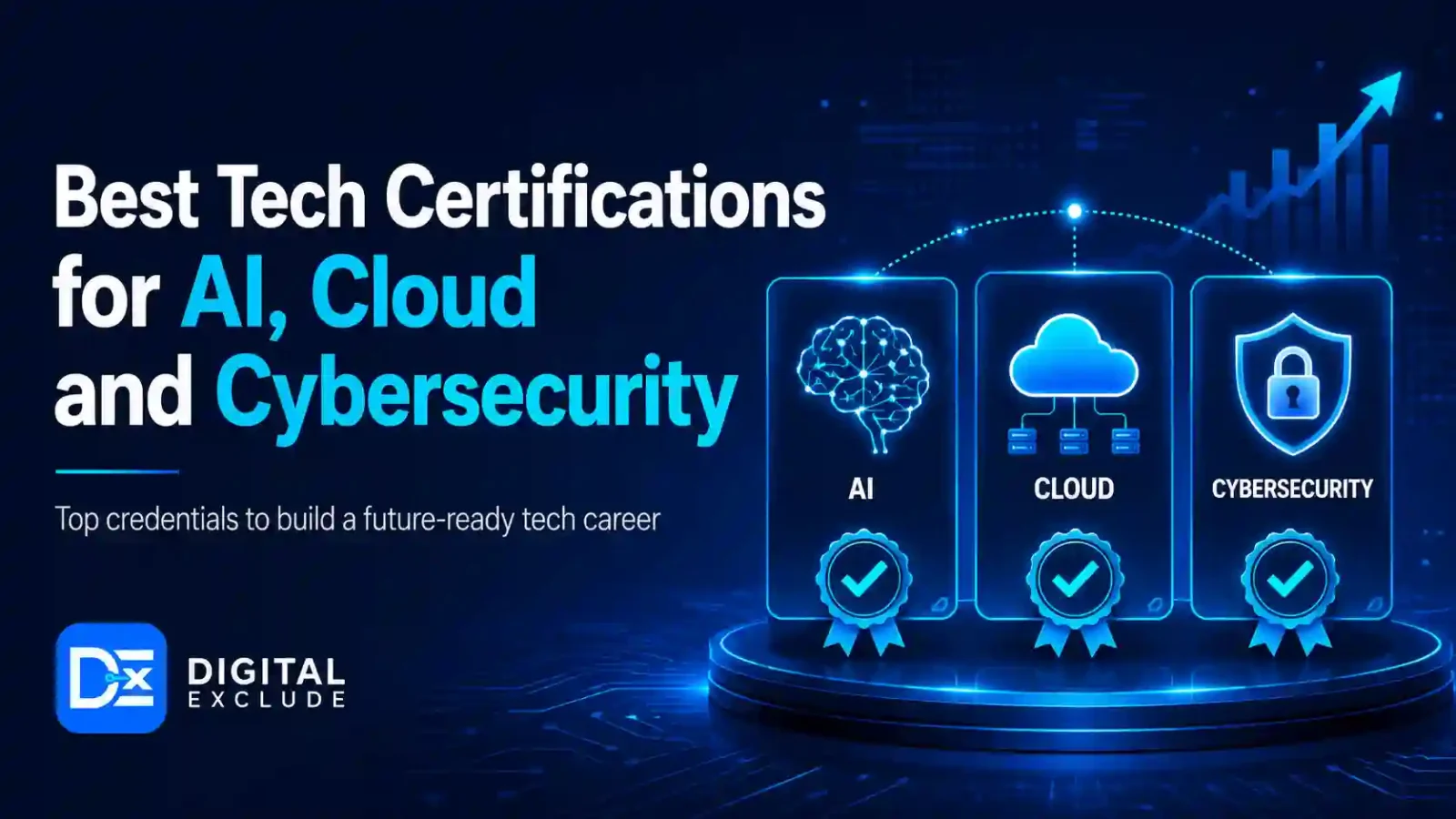
The Best Tech Certifications to start a career in AI, cloud, and cybersecurity are the ones that match your current level, budget, and target role. Beginners can start with foundation level options such as AWS Certified Cloud Practitioner, Microsoft Azure Fundamentals, Google Cloud Digital Leader, AWS Certified AI Practitioner, Microsoft Azure AI Fundamentals, ISC2 Certified in Cybersecurity, Cisco CCST Cybersecurity, and CompTIA Security+.
A good certification should help you prove practical skills, not just collect a badge. Before paying for any exam, check the latest exam version, fees, renewal rules, hands-on practice requirements, and whether the certification matches the jobs you are applying for.
Introduction
Many students, working professionals, small business owners, tech beginners, Android users, and cybersecurity learners want to build a career in technology but do not know where to start. AI, cloud computing, and cybersecurity all look promising, but the certification market is crowded. Some courses are useful. Some are too advanced. Some are too expensive for beginners. Some look attractive but do not match real job requirements.
This guide explains the Best Tech Certifications for people who want to start a career in AI, cloud, and cybersecurity in 2026. It does not promise that one certificate will get you a job immediately. Instead, it shows which certifications are practical starting points, what each one is useful for, and how to choose the right path without wasting money.
The goal is simple: help you choose a certification that fits your background, learning style, and career plan.
What Do Tech Certifications Mean?
Tech Certifications are formal credentials that show you have learned specific technology skills and passed an exam or assessment. They are commonly offered by cloud providers, cybersecurity bodies, technology companies, and training platforms.
A certification can help you show knowledge in areas such as:
- Cloud computing basics
- AI and generative AI concepts
- Cybersecurity principles
- Networking fundamentals
- Secure access and identity
- Risk management
- Cloud platforms such as AWS, Azure, and Google Cloud
- AI services and business use cases
- Security monitoring and incident response basics
A certification is not the same as job experience. It is a signal. Employers may value it more when it is supported by projects, labs, internships, GitHub work, practical notes, or real examples of what you can do.
Why Best Tech Certifications Matter in 2026
Tech hiring is changing because AI, cloud, and cybersecurity are now connected. A cloud engineer needs to understand security. A cybersecurity analyst needs to understand cloud logs and identity access. An AI beginner needs to understand responsible use, privacy, and data handling.
The World Economic Forum’s Future of Jobs Report 2025 identified AI and big data as among the fastest-growing skills, followed closely by networks, cybersecurity, and technology literacy for the 2025 to 2030 period. This makes structured learning more important for beginners who want to enter the tech job market with a clear direction.
In 2026, certifications matter for three main reasons:
- They give beginners a structured learning path.
- They help career switchers prove basic technical understanding.
- They help working professionals move into AI, cloud, or cybersecurity roles with more confidence.
But certification choice matters. A beginner should not start with a highly advanced certification just because it sounds impressive. The right first certification should build a base and support the next step.
Best Tech Certifications for AI, Cloud and Cybersecurity in 2026
Below are practical certification options for beginners and early-career professionals. The list is grouped by career direction so you can choose based on your goal.
Which AI Certifications Are Best for Beginners?
AI certifications are useful if you want to work with AI tools, generative AI workflows, prompt-based productivity, AI services, or basic AI application development. Beginners should start with AI fundamentals before moving into machine learning engineering or data science.
1. AWS Certified AI Practitioner
Best for: Beginners who want to understand AI, machine learning, generative AI, and AWS AI services.
AWS Certified AI Practitioner is designed for people who want to demonstrate foundational knowledge of AI concepts and AWS AI tools. AWS says the exam focuses on practical business applications of AI and covers AI, machine learning, generative AI concepts, and related AWS services.
Why it is useful:
- Good for beginners who already like AWS or cloud services
- Suitable for business users, students, and early technical learners
- Helps you understand AI terms used in cloud environments
- Useful before moving into deeper AI engineering paths
Be careful:
If you are completely new to IT and AWS Cloud, AWS recommends starting with AWS Cloud Practitioner Essentials or AWS Technical Essentials.
2. Microsoft Azure AI Fundamentals
Best for: Beginners who want to understand AI concepts inside Microsoft Azure.
Microsoft Azure AI Fundamentals validates basic AI concepts related to building software and services on Azure. The official certification page lists areas such as machine learning, computer vision, natural language processing, generative AI, and AI responsibilities.
Why it is useful:
- Beginner friendly for people interested in Azure
- Good for students and professionals using Microsoft tools
- Covers AI workloads in a structured way
- Useful before moving into applied Azure AI development
Important 2026 note:
Microsoft states that exam AI 900 will retire on June 30, 2026, and will be replaced by AI 901. Check the current exam before preparing or booking.
3. Google Cloud Generative AI Leader
Best for: Non technical professionals, managers, business owners, and beginners who want to understand generative AI in business.
Google Cloud Generative AI Leader is a foundational certification focused on generative AI concepts and organizational use. Google lists the exam as 90 minutes, 50 to 60 multiple choice questions, with no prerequisites, and a three-year validity period.
Why it is useful:
- Good for non technical learners
- Useful for business, marketing, product, and operations roles
- Helps you understand responsible AI use
- Good option before technical AI certifications
Be careful:
This is not a deep coding certification. If your goal is AI engineering, use it as a first step, then build Python, data, API, and cloud project skills.
4. IBM Applied AI or AI Developer Professional Certificate
Best for: Learners who want a project based AI learning path.
IBM’s Applied AI Professional Certificate badge page says learners complete courses on Coursera that include quizzes, hands on assignments, and projects. IBM also describes its AI Developer Professional Certificate as a path for future coders who want to build and deploy AI models in real world environments.
Why it is useful:
- Good for learners who prefer guided online study
- Includes projects and assignments
- Useful for building a portfolio
- Better for practice than only reading theory
Be careful:
Professional certificates from learning platforms can be useful, but employers may treat them differently from proctored vendor exams. Use them with projects, GitHub samples, and practical demos.
Which Cloud Certifications Are Best for Beginners?
Cloud certifications are useful if you want roles in cloud support, cloud operations, DevOps, system administration, cybersecurity, data, or AI deployment.
5. AWS Certified Cloud Practitioner
Best for: Absolute beginners and career switchers entering cloud.
AWS Certified Cloud Practitioner validates foundational understanding of AWS Cloud, services, and terminology. AWS describes it as a good starting point for people with no prior IT or cloud experience who are switching to a cloud career or need cloud literacy.
Why it is useful:
- Strong first cloud certification
- Good for non technical and technical beginners
- Useful for support, sales, business, operations, and junior cloud roles
- Builds vocabulary for AWS services
Be careful:
This is a foundation-level certification. It does not prove you can build production cloud systems. After this, add hands-on labs in compute, storage, IAM, networking, and monitoring.
6. Microsoft Azure Fundamentals
Best for: Beginners who want to learn cloud concepts and Azure basics.
Microsoft Azure Fundamentals validates foundational knowledge of cloud concepts, Azure services, management, and governance. Microsoft lists it as a beginner-level certification.
Why is it useful:
- Good for students and professionals in Microsoft-based companies
- Useful for support, admin, business, and cloud learner roles
- Helps you understand Azure terminology
- Good base before Azure Administrator or AI-related Azure certifications
Be careful:
Do not stop at theory. Create a free or low-cost lab environment where possible and practice resource groups, identity, storage, virtual machines, and cost monitoring.
7. Google Cloud Digital Leader
Best for: Beginners, business users, and people who want to understand Google Cloud at a high level.
Google Cloud Digital Leader is for people who want to demonstrate knowledge of cloud computing basics and how Google Cloud products and services support organisational goals. Google’s certification overview also lists Cloud Digital Leader and Generative AI Leader as foundational options with no technical prerequisites.
Why is it useful:
- Good for non-technical learners
- Useful for business roles, product roles, and early cloud learners
- Helps you understand cloud use cases
- Good for people comparing AWS, Azure, and Google Cloud paths
Be careful:
This is not enough for a cloud engineering role. Add hands-on practice with cloud projects, identity, networking, storage, and deployment.
Which Cybersecurity Certifications Are Best for Beginners?
Cybersecurity certifications are useful for learners who want to work in security operations, IT support, cloud security, compliance, risk, incident response, or security awareness.
8. ISC2 Certified in Cybersecurity
Best for: Beginners with little or no cybersecurity experience.
ISC2 Certified in Cybersecurity is an entry-level certification with no work experience required. The official page lists exam domains such as security principles, business continuity, disaster recovery, incident response concepts, access controls, network security, and security operations.
ISC2 also states that it is offering free Certified in Cybersecurity online self-paced training and exams to one million people as part of its initiative to expand the cybersecurity workforce.
Why it is useful:
- Good first cybersecurity certification
- No work experience required
- Covers security basics clearly
- Useful for students, beginners, and career switchers
Important 2026 note:
ISC2 says that effective September 1, 2026, the CC exam will be based on a new exam outline. Check the latest outline before studying.
9. CompTIA Security+
Best for: Beginners who want a respected entry-level cybersecurity certification.
CompTIA Security+ focuses on essential skills required for core security functions and a career in IT security. CompTIA describes it as covering practical, hands-on skills for securing networks, applications, and devices, along with data confidentiality, integrity, and availability.
Why it is useful:
- Strong entry-level cybersecurity credential
- Vendor neutral
- Useful for security analysts, IT support, and junior security roles
- Covers broad security concepts
Be careful:
Security+ can feel heavy if you do not understand basic networking. If terms like TCP/IP, DNS, ports, firewalls, and subnets feel new, study networking basics first.
10. Cisco CCST Cybersecurity
Best for: Learners who want entry-level cybersecurity skills with a networking context.
Cisco says the CCST Cybersecurity certification validates entry-level cybersecurity concepts, including security principles, network and endpoint security, vulnerability assessment, risk management, and incident handling. Cisco also describes it as a first step toward its Cybersecurity Associate certification.
Why it is useful:
- Good for students and early learners
- Useful for people interested in network security
- Helps build job-ready basics
- Pairs well with networking study
Be careful:
Do not treat cybersecurity as only tool usage. Learn how networks, operating systems, identity, and logs work.
11. Cisco CCST Networking
Best for: People who want a networking base before cloud or cybersecurity.
Cisco says CCST Networking validates entry-level networking concepts and shows foundational knowledge of how networks operate, including devices, media, and protocols. Cisco also says it is a first step toward CCNA.
Why it is useful:
- Good before cybersecurity
- Good before cloud networking
- Useful for support and network technician roles
- Helps you understand how systems connect
Be careful:
Networking can feel theoretical if you only read. Use packet tracer style labs, diagrams, and command line practice.
12. CompTIA A+
Best for: Absolute beginners who need IT support basics before AI, cloud, or cybersecurity.
CompTIA A+ is positioned for starting an IT career and requires two exams covering hardware, networking, operating systems, and security.
Why it is useful:
- Good for people with no IT background
- Helps with help desk and support roles
- Builds device, OS, and troubleshooting basics
- Useful before Security+, cloud, or networking certifications
Be careful:
If you already have IT support experience, you may not need A+. Review the exam objectives before paying.
Comparison Table: Best Tech Certifications by Career Goal
| Needs hands-on practice | Track | Best For | Level | Main Value | Watch Out For |
| AWS Certified AI Practitioner | AI | Beginners interested in AWS AI | Foundation | AI and GenAI concepts on AWS | Better after basic AWS knowledge |
| Microsoft Azure AI Fundamentals | AI | Learners using Microsoft tools | Foundation | AI concepts on Azure | AI 900 retires June 30, 2026 |
| Google Cloud Generative AI Leader | AI | Non technical and business learners | Foundation | GenAI use cases and concepts | Not a coding certification |
| IBM Applied AI or AI Developer Certificate | AI | Project based learners | Beginner to intermediate | Hands on assignments and projects | Employer recognition may vary |
| AWS Certified Cloud Practitioner | Cloud | Cloud beginners and career switchers | Foundation | AWS cloud vocabulary and services | Needs labs after exam |
| Microsoft Azure Fundamentals | Cloud | Azure beginners | Foundation | Cloud concepts and Azure basics | Not enough for cloud admin role |
| Google Cloud Digital Leader | Cloud | Business and cloud beginners | Foundation | Google Cloud business use cases | Needs practical cloud practice |
| ISC2 Certified in Cybersecurity | Cybersecurity | New cybersecurity learners | Entry level | Security basics, no work experience required | Exam outline changes in Sept 2026 |
| CompTIA Security+ | Cybersecurity | Junior security and IT learners | Entry level | Broad security knowledge | Networking basics needed |
| Cisco CCST Cybersecurity | Cybersecurity | Entry level security learners | Entry level | Security and incident basics | Add labs and networking practice |
| Cisco CCST Networking | Networking | Cloud and cyber beginners | Entry level | Networking foundation | Needs hands on practice |
| CompTIA A+ | IT basics | Absolute beginners | Entry level | Hardware, OS, support basics | May be too basic for experienced learners |
How Should You Choose the Right Certification?
If You Are a Student
Start with a foundation certification and one practical project.
Good options:
- ISC2 Certified in Cybersecurity
- Cisco CCST Cybersecurity
- AWS Cloud Practitioner
- Azure Fundamentals
- Google Cloud Digital Leader
- AWS Certified AI Practitioner
Best project ideas:
- Build a simple cloud-hosted static website
- Create a cybersecurity checklist for a small business
- Analyse a sample phishing email
- Create an AI tool comparison report
- Build a beginner cloud cost tracker
If You Are a Working Professional
Choose a certification linked to your current job.
Examples:
- Marketing or operations professional: Google Cloud Generative AI Leader
- IT support professional: CompTIA Security+ or Azure Fundamentals
- Developer: AWS AI Practitioner or Azure AI Fundamentals
- Business analyst: Google Cloud Digital Leader
- System admin: AWS Cloud Practitioner, Azure Fundamentals, or Security+
The fastest learning path is usually not a random certification. It is a certification that connects with work you already understand.
If You Are a Small Business Owner
Do not chase advanced technical exams first. Start with practical awareness.
Useful options:
- Google Cloud Generative AI Leader
- AWS Certified AI Practitioner
- Google Cloud Digital Leader
- ISC2 Certified in Cybersecurity
These can help you understand AI tools, cloud risks, cybersecurity basics, and vendor decisions without needing to become an engineer.
If You Are an Android User or Tech Beginner
Start with safe and practical basics.
Useful options:
- CompTIA A+
- Cisco CCST Networking
- ISC2 Certified in Cybersecurity
- Google Cloud Digital Leader
These help you understand devices, apps, networks, security, permissions, and cloud services better.
If You Want a Cybersecurity Career
A practical beginner path can look like this:
- Learn networking basics.
- Study operating system basics.
- Take the ISC2 Certified in Cybersecurity or Cisco CCST Cybersecurity.
- Move to CompTIA Security+.
- Build hands-on labs using legal practice environments.
- Learn log analysis, phishing investigation, cloud security, and identity basics.
Do not skip networking. Cybersecurity becomes much easier when you understand how systems communicate.
Real World Examples
Example 1: A Student Wants an AI Career
A student with basic computer skills wants to enter AI but does not know Python yet.
Better path:
- Start with Google Cloud Generative AI Leader or AWS Certified AI Practitioner.
- Learn basic Python.
- Complete a project-based AI certificate.
- Build small projects such as a chatbot, document summariser, or AI note organiser.
- Learn privacy and responsible AI basics.
This path is more realistic than jumping directly into advanced machine learning math.
Example 2: A Support Executive Wants a Cloud Role
A working professional in IT support wants to move into the cloud.
Better path:
- Start with AWS Certified Cloud Practitioner or Azure Fundamentals.
- Learn Linux and networking basics.
- Build cloud labs.
- Learn IAM, storage, virtual machines, monitoring, and billing.
- Move toward AWS Solutions Architect Associate or Azure Administrator later.
The first certification gives structure. The labs create confidence.
Example 3: A Beginner Wants Cybersecurity
A beginner wants to become a cybersecurity analyst but has no IT background.
Better path:
- Learn basic networking.
- Study Windows and Linux basics.
- Take the ISC2 Certified in Cybersecurity or the Cisco CCST Cybersecurity.
- Move to CompTIA Security+.
- Practise with legal labs.
- Learn how to read alerts and logs.
A cybersecurity certificate alone is not enough. Employers want proof that you can think through real incidents.
Example 4: A Small Business Owner Wants Safer AI Use
A business owner wants to use AI tools but is worried about data privacy.
Better path:
- Take a beginner AI certification focused on responsible use.
- Learn basic cloud and cybersecurity terms.
- Create internal rules for AI tool use.
- Avoid uploading customer data to unknown tools.
- Review pricing, permissions, and data retention before using AI apps.
This reduces risk without needing a full technical background.
Common Mistakes to Avoid
Mistake 1: Choosing a Certification Only Because It Is Popular
A certification should match your target role. AWS Cloud Practitioner is useful for cloud literacy, but it is not enough for a cloud engineer job. Security+ is useful for cybersecurity, but it may feel difficult without networking basics.
Mistake 2: Ignoring Exam Version Changes
Certification exams change. Microsoft has announced that AI 900 will retire on June 30, 2026 and be replaced by AI 901. ISC2 has also announced a new CC exam outline effective September 1, 2026. Always check the official exam page before preparing.
Mistake 3: Paying Before Checking the Total Cost
Exam fees are only one part of the cost. You may also pay for training, practice tests, retakes, labs, cloud usage, renewal, and study material. Prices can vary by country, tax, bundle, and provider.
Mistake 4: Collecting Certificates Without Projects
Many beginners collect badges but cannot explain what they built. This is weak for interviews.
Better approach:
For every certification, create one practical proof:
- A cloud architecture diagram
- A small AI app
- A phishing analysis report
- A network diagram
- A security checklist
- A basic incident response note
- A cost estimation sheet
Mistake 5: Skipping Security and Privacy Basics
AI and cloud learners often ignore security until later. That is risky. Learn passwords, MFA, access control, permissions, logging, backups, and data privacy from the beginning.
Mistake 6: Believing One Certification Guarantees a Job
No certification can guarantee a job. It can improve your profile, but hiring also depends on projects, communication, interview preparation, location, experience, and job market conditions.
Step-by-Step Tips to Choose and Prepare
Step 1: Pick One Career Direction
Choose one primary direction first:
- AI
- Cloud
- Cybersecurity
- IT support
- Networking
You can combine them later, but beginners should avoid studying everything at once.
Step 2: Match the Certification to Your Level
Use this simple rule:
| Your Current Level | Better Starting Point |
| No IT background | CompTIA A+, Cisco CCST Networking |
| Basic IT knowledge | AWS Cloud Practitioner, Azure Fundamentals |
| Interest in AI tools | AWS AI Practitioner, Azure AI Fundamentals |
| Interest in cyber | ISC2 CC, Cisco CCST Cybersecurity |
| Some networking knowledge | CompTIA Security+ |
| Business role | Google Cloud Digital Leader, Gen AI Leader |
Step 3: Read the Official Exam Guide
Do not depend only on YouTube videos or random notes. Download or read the official exam guide first. It tells you what is actually tested.
Step 4: Create a Study Plan
A simple beginner plan:
- Week 1: Read exam domains and basic terms
- Week 2: Watch structured lessons
- Week 3: Take notes and build small labs
- Week 4: Do practice questions
- Week 5: Review weak areas
- Week 6: Take mock exams and book only when ready
Adjust this based on your available time.
Step 5: Build One Practical Project
Examples:
| Track | Project Idea |
| AI | Create an AI use case checklist for a business |
| Cloud | Host a static website on cloud storage |
| Cybersecurity | Analyse sample phishing emails |
| Networking | Draw and explain a small office network |
| IT support | Create a troubleshooting guide for common PC issues |
Step 6: Check Privacy and Pricing
Before using any learning platform or lab environment:
- Check subscription cost
- Check renewal terms
- Check cancellation policy
- Check cloud free tier limits
- Set billing alerts
- Avoid uploading private files
- Use test data for labs
- Store passwords in a password manager
Step 7: Prepare for Interviews While Studying
Do not wait until after the exam.
Prepare answers for:
- Why did you choose this certification?
- What did you learn?
- What project did you build?
- What problem did you solve?
- What mistakes did you make during practice?
- How would you use this skill in a real job?
Pros and Cons of Tech Certifications
| Pros | Cons |
| Gives beginners a clear learning structure | Can be expensive if chosen poorly |
| Helps prove basic knowledge | Does not replace experience |
| Useful for career switchers | Some certificates have limited employer value |
| Helps with interview confidence | Exam versions can change |
| Supports AI, cloud, and cyber career paths | Too many certificates without projects look weak |
| Encourages disciplined study | Renewal rules may apply |
Final Recommendation
If you are confused, use this simple path:
For AI
Start with:
- AWS Certified AI Practitioner
- Microsoft Azure AI Fundamentals
- Google Cloud Generative AI Leader
Then add Python, APIs, data basics, responsible AI, and small projects.
For Cloud
Start with:
- AWS Certified Cloud Practitioner
- Microsoft Azure Fundamentals
- Google Cloud Digital Leader
Then add labs in IAM, storage, networking, compute, monitoring, and cost control.
For Cybersecurity
Start with:
- ISC2 Certified in Cybersecurity
- Cisco CCST Cybersecurity
- CompTIA Security+
Then add networking, Linux, Windows basics, log analysis, phishing investigation, and legal labs.
For Absolute Beginners
Start with:
- CompTIA A+
- Cisco CCST Networking
- Then choose cloud, AI, or cybersecurity
This approach is slower than chasing advanced certifications, but it is more practical.
FAQs
What are the Best Tech Certifications for beginners?
The Best Tech Certifications for beginners include AWS Certified Cloud Practitioner, Microsoft Azure Fundamentals, Google Cloud Digital Leader, AWS Certified AI Practitioner, Microsoft Azure AI Fundamentals, ISC2 Certified in Cybersecurity, Cisco CCST Cybersecurity, and CompTIA Security+.
Which certification is best for starting a cloud career?
AWS Certified Cloud Practitioner, Microsoft Azure Fundamentals, and Google Cloud Digital Leader are good starting points. Choose based on the cloud platform used by your target companies or the one you want to learn first.
Which certification is best for starting a cybersecurity career?
ISC2 Certified in Cybersecurity and Cisco CCST Cybersecurity are good beginner options. CompTIA Security+ is also valuable, but it is easier if you already understand networking basics.
Which AI certification should a beginner choose?
Beginners can consider AWS Certified AI Practitioner, Microsoft Azure AI Fundamentals, or Google Cloud Generative AI Leader. Choose AWS, Azure, or Google based on the platform you want to use.
Are Tech Certifications enough to get a job?
No. Tech Certifications can support your profile, but they are stronger when combined with projects, labs, interview preparation, communication skills, and a clear understanding of real problems.
Should I choose AI, cloud, or cybersecurity first?
Choose based on your interest and current skills. If you like automation and apps, start with AI. If you like infrastructure and deployment, start with the cloud. If you like risk, investigation, and protection, start with cybersecurity.
Are free certifications useful?
Free certifications or free training can be useful if they teach real skills and come from a credible provider. Still, check whether the certification includes an assessment, practical work, and current content.
How many certifications should I complete in one year?
For beginners, one or two well-chosen certifications with projects are better than five certificates without practical proof. Quality matters more than quantity.
Conclusion
The Best Tech Certifications in 2026 are not the most expensive or the most popular ones. They are the certifications that match your level, help you build practical skills, and support a clear career direction in AI, cloud, or cybersecurity.
Start with a foundation-level certification, study from the official exam guide, build one project, and check costs before paying. If you are new to tech, build IT and networking basics first. If you already have some experience, choose a certification that connects with your next role.
Tech Certifications can open doors, but your real advantage comes from combining certification knowledge with hands-on practice, problem-solving, and clear communication.
