The Google Cloud generative AI leader certification is for learners and professionals who want to understand generative AI from a business, strategy, and Google Cloud point of view. It is not a coding-heavy AI engineering exam. It is also not just a simple AI awareness badge.
This certification is designed for people who need to understand how generative AI can be used in real business situations. That includes AI learners, cloud learners, product managers, consultants, business analysts, founders, students, and working professionals who want to evaluate AI use cases, understand Google Cloud AI offerings, and discuss AI adoption with technical and non-technical teams.
If you are preparing for this exam, the main question is not only “Can I pass?” The better question is, “Will this certification help my role, resume, projects, or AI learning path?” This guide answers that honestly.
Quick Answer
The Google Cloud Generative AI Leader certification is a beginner-friendly Google Cloud exam for people who want business-level generative AI knowledge. It has no prerequisites, costs $99 plus applicable tax, runs for 90 minutes, includes 50 to 60 multiple-choice questions, and is valid for 3 years. It is best for AI learners, cloud learners, product teams, consultants, and non-technical professionals.
Who This Guide Is For
This guide is useful for:
- AI learners who want a recognized generative AI credential
- Cloud learners comparing Google Cloud with AWS or Azure
- Students exploring AI and cloud careers
- Working professionals using AI in daily workflows
- Product managers involved in AI features or AI adoption
- Business analysts working with technology teams
- Consultants advising clients on AI use cases
- Founders evaluating AI tools before hiring technical teams
- Non-technical professionals who need AI fluency
- Developers who want Google Cloud AI context before deeper technical learning
- Career switchers who want a practical AI and cloud certification path
For more learning options, you can also explore Digital Exclude’s Courses and Certifications section.
What Is the Google Cloud Generative AI Leader Certification?
The Google Cloud Generative AI Leader certification validates your understanding of generative AI concepts, Google Cloud’s generative AI products, responsible AI, model output improvement, and business strategy for AI adoption.
This is a leader-level certification in the practical sense, not because it requires executive experience, but because it focuses on decisions, use cases, risks, strategy, and business value. You are expected to know how generative AI can transform work, where it can fail, what Google Cloud tools are relevant, and how to think about secure and responsible implementation.
It is different from a developer certification. You do not need to build a full AI application during the exam. You do need to understand concepts such as foundation models, large language models, prompt engineering, grounding, retrieval augmented generation, model limitations, data quality, privacy, responsible AI, and Google Cloud’s AI offerings.
Google Cloud Generative AI Leader Exam Details
| Field | Details |
| Certification name | Google Cloud Generative AI Leader |
| Provider | Google Cloud |
| Level | Beginner to business practitioner |
| Prerequisites | None |
| Exam duration | 90 minutes |
| Exam format | 50 to 60 multiple-choice questions |
| Exam cost | $99 plus applicable tax |
| Delivery method | Online-proctored or onsite-proctored |
| Languages | English, Japanese, Spanish, Portuguese |
| Validity | 3 years |
| Main focus | Generative AI strategy, Google Cloud AI offerings, responsible AI, output quality |
| Best for | AI learners, cloud learners, professionals, consultants, and product teams |
| Main limitation | Not a deep AI engineering or coding certification |
| Last verified | July 2026 |
Is This a Beginner Certification?
Yes, but with one condition. It is beginner-friendly for people who want to understand generative AI at a business and platform level. It is not beginner-friendly if you expect to memorize a few definitions without understanding use cases.
You do not need prior Google Cloud certification. You do not need deep coding experience. You do not need to train machine learning models. But you should understand how AI tools are used in real work and why businesses need security, privacy, governance, data quality, and responsible AI.
A complete beginner can prepare for this exam, but should not skip AI fundamentals. Start with basic concepts such as artificial intelligence, machine learning, natural language processing, foundation models, large language models, multimodal models, and prompt engineering.
Who Should Take the Certification?
| Learner Type | Recommendation | Why |
| Complete beginners | Yes, with the study | No prerequisites, but AI basics are needed |
| Students | Yes | Useful for AI and cloud awareness |
| Working professionals | Yes | Good for AI adoption and business workflows |
| Non-technical professionals | Yes | Focus is not heavy coding |
| Product managers | Yes | Helps with use cases, risks, and AI strategy |
| Consultants | Yes | Useful for client conversations around generative AI |
| Developers | Yes, but not enough alone | Add hands-on Google Cloud AI projects |
| Cloud learners | Yes | Good Google Cloud AI entry point |
| AI engineers | Optional | Too broad if you already need deep technical proof |
| Job seekers | Useful as support | Projects and skills still matter more |
Who Should Avoid It?
Avoid this certification as your first paid exam if you only want hands-on coding, model training, MLOps, fine-tuning, or production AI engineering skills. This exam does not prove that you can build production AI systems.
Also, avoid taking the exam too early if you do not understand basic generative AI terms. If words like RAG, grounding, hallucination, prompt chaining, multimodal model, foundation model, and responsible AI feel completely new, study them first.
If your goal is a hands-on cloud engineering role, you may also need broader Google Cloud skills. For that, compare related options in Digital Exclude’s best cloud certifications guide.
Google Cloud Generative AI Leader Exam Topics and Weightage
The official exam guide divides the exam into four main sections.
| Exam Section | Approximate Weight | What It Means |
| Fundamentals of gen AI | 30% | Core AI, ML, NLP, foundation models, data, use cases |
| Google Cloud’s gen AI offerings | 35% | Google Cloud AI products, Gemini, Agent Platform, RAG offerings |
| Techniques to improve gen AI model output | 20% | Prompting, grounding, RAG, monitoring, evaluation, limitations |
| Business strategies for a successful gen AI solution | 15% | Use case selection, secure AI, privacy, responsible AI, governance |
The highest weight is Google Cloud’s gen AI offerings, so do not prepare only from generic AI tutorials. You need to understand Google Cloud’s product direction and how its AI tools support business use cases.
Section 1: Fundamentals of Generative AI
This section checks whether you understand the basics of generative AI and its business implications.
Study topics include:
- Artificial intelligence
- Machine learning
- Natural language processing
- Generative AI
- Foundation models
- Multimodal foundation models
- Diffusion models
- Prompt engineering
- Large language models
- Supervised, unsupervised, and reinforcement learning
- Data ingestion and preparation
- Model training and deployment basics
- Structured and unstructured data
- Labeled and unlabeled data
- Business use cases for text, image, code, video, data analysis, and personalization
Practical example:
A retail company wants to use AI to create product descriptions. For the exam, you should understand that this is a text generation use case, but you should also think about data quality, brand tone, review process, hallucination risk, and whether the content needs human approval.
Section 2: Google Cloud’s Generative AI Offerings
This is the biggest exam area. It focuses on Google Cloud’s generative AI ecosystem and how different tools support business needs.
Study topics include:
- Gemini
- Gemma
- Imagen
- Veo
- Gemini app and Gemini Advanced
- Gemini Enterprise
- Gemini for Google Workspace
- NotebookLM related business value
- Google AI Studio
- Agent Platform
- Agent Search
- Model Garden
- RAG APIs
- Pre-built RAG with Agent Search
- Google Cloud AI APIs
- Customer engagement and conversational agents
- Cloud Storage, Cloud Functions, Cloud Run, and API usage for agent tooling
This does not mean you need to become an expert in every Google Cloud AI product. But you should know what each category is used for and how it supports a business scenario.
Practical example:
If a company wants an internal knowledge assistant for HR policies, you should understand that a RAG-based approach may help ground responses in company documents instead of relying only on a model’s general training.
Section 3: Techniques to Improve Generative AI Output
This section tests how you think about better, safer, and more reliable model responses.
Study topics include:
- Prompt engineering
- Zero-shot prompting
- One-shot prompting
- Few-shot prompting
- Role prompting
- Prompt chaining
- ReAct prompting
- Grounding
- Retrieval augmented generation
- Fine-tuning basics
- Human in the loop
- Hallucinations
- Bias and fairness
- Knowledge cutoff
- Edge cases
- Monitoring and evaluation
- Output settings such as token count, temperature, top-p, safety settings, and output length
Practical example:
A customer support chatbot gives outdated refund information. A weak answer is “write a better prompt.” A stronger answer is to ground the system with current policy documents, use RAG, add human review for sensitive cases, monitor answer quality, and update the knowledge source.
This is also where safety matters. If you use AI tools for web research, read Digital Exclude’s guide on AI browsers to understand why source verification is still important.
Section 4: Business Strategy for Generative AI Solutions
This section is where the “Leader” part becomes clear. You need to understand how businesses should select, implement, secure, and measure generative AI initiatives.
Study topics include:
- Choosing the right gen AI use case
- Understanding business requirements
- Understanding technical constraints
- Selecting the right gen AI solution
- Integrating gen AI into an organization
- Measuring business impact
- Secure AI
- Google Secure AI Framework
- Identity and Access Management
- Security Command Center
- Privacy risks
- Data anonymization
- Pseudonymization
- Bias and fairness
- Accountability
- Explainability
- Transparency
Practical example:
A healthcare company wants to use gen AI to summarize patient notes. The exam may expect you to think beyond productivity. You should consider privacy, access control, compliance, hallucination risk, human review, data quality, and whether the system should be used for support rather than final decisions.
For small business use cases, Digital Exclude’s AI automation guide can help you connect AI adoption with practical workflows.
Google Cloud Generative AI Leader Exam Cost
The official exam fee is $99 plus applicable tax.
For learners in India, the final cost may vary based on tax, currency conversion, and payment method. For learners in the USA, tax may also apply depending on billing details. Always check the official registration page before paying because exam pricing and policies can change.
Do not pay for the exam on day one. First complete the official learning path, read the exam guide, attempt sample questions, and check whether you can explain the four exam domains in your own words.
Prerequisites: What Should You Know Before Starting?
Officially, there are no prerequisites. Practically, you should know the following before booking the exam:
- Basic AI terms
- What generative AI does
- What large language models are
- What prompt engineering means
- Why hallucinations happen
- What RAG means at a conceptual level
- How businesses use AI tools
- Basic cloud concepts
- Why privacy and security matter
- What responsible AI means
You do not need advanced Python. You do not need machine learning math. You do not need deep Google Cloud administration skills. But you should not treat the exam as a simple vocabulary test.
Official Study Resources
Use these official resources first:
- Google Cloud Generative AI Leader certification page
- Google Cloud Generative AI Leader learning path
- Generative AI Leader exam guide
- Google Cloud sample questions
- Google Cloud Skills Boost
- Google Cloud Free Program
Use third-party videos or notes only after you understand the official exam guide. The official guide should decide your study priorities.
30 Day Study Plan
Week 1: Learn Generative AI Fundamentals
Focus on the first exam section.
Study:
- AI, ML, NLP, and generative AI
- Foundation models
- LLMs
- Multimodal models
- Prompt engineering
- Data quality
- Structured and unstructured data
- Model lifecycle basics
Practice task:
Write five business use cases for generative AI. For each, mention the output type, possible risk, and where human review is needed.
Week 2: Study Google Cloud Gen AI Offerings
Focus on Google Cloud tools and offerings.
Study:
- Gemini
- Gemma
- Imagen
- Veo
- Gemini Enterprise
- Gemini for Google Workspace
- Google AI Studio
- Agent Platform
- Agent Search
- RAG offerings
- Google Cloud AI APIs
Practice task:
Create a table with three columns: Google Cloud offering, what it does, and one business use case.
Week 3: Learn Output Improvement Techniques
Focus on improving quality and reducing risk.
Study:
- Prompting methods
- Grounding
- RAG
- Fine tuning basics
- Human in the loop
- Model limitations
- Bias
- Hallucinations
- Evaluation and monitoring
- Safety settings
Practice task:
Take one use case, such as customer support, and write three versions of a prompt. Compare which prompt gives the best result and why.
Week 4: Study Business Strategy and Responsible AI
Focus on the leadership part of the exam.
Study:
- Use case selection
- Business requirements
- Technical constraints
- Secure AI
- Privacy
- Data anonymization
- Responsible AI
- Bias and fairness
- Accountability and explainability
- Measuring AI impact
Practice task:
Write a one-page AI adoption plan for a company. Include use case, users, data source, risk, security control, expected benefit, and human review process.
Final 2 Days: Review and Practice
Use the official sample questions. Do not rely on the sample score as a guarantee. Use it to understand the question style.
Before booking the exam, you should be able to explain:
- What generative AI is
- How Google Cloud supports gen AI adoption
- How RAG improves output reliability
- Why responsible AI matters
- How to choose a business use case
- What risks need review before deployment
How Difficult Is the Exam?
The exam is not deeply technical, but it is not meaningless. The difficulty depends on your background.
For business professionals, the hardest part may be Google Cloud product knowledge. For cloud learners, the hardest part may be responsible AI and business strategy. For AI learners, the hardest part may be mapping AI concepts to Google Cloud offerings.
Most learners should not need months of preparation. A focused 3 to 4 week study plan can be enough if you already understand basic AI and cloud concepts. Complete beginners may need more time.
Is the Certification Worth It?
The certification can be worth it if you want to show that you understand generative AI from a Google Cloud and business adoption perspective.
It is useful for:
- Product managers
- Business analysts
- Consultants
- Cloud learners
- AI project coordinators
- Technical sales professionals
- Founders
- Working professionals using AI
- Students building an AI and cloud profile
It is less useful if your goal is pure AI engineering. For engineering roles, you need hands-on work with Python, APIs, cloud deployment, model evaluation, RAG implementation, and real projects.
A good way to use this certification is to pair it with a small project. For example, build a simple internal FAQ assistant plan, a document summarization workflow, or an AI use case evaluation template.
Career Value and Limitations
This certification can support your resume, but it should not be your only proof of AI skill.
It can help you show:
- You understand generative AI terms
- You know Google Cloud’s gen AI direction
- You can discuss business AI use cases
- You understand responsible AI and security concerns
- You can work with technical and non-technical teams
It does not prove:
- You can code AI applications
- You can train models
- You can deploy production AI systems
- You can manage MLOps pipelines
- You can build advanced AI agents from scratch
If you want a broader certification path, compare this with other options in Digital Exclude’s best tech certifications article.
Free vs Paid Preparation
Free preparation is enough for many learners. Start with the official certification page, learning path, exam guide, and sample questions. Add Google Cloud Skills Boost resources if you want more structured practice.
Paid preparation may help if you need:
- A fixed study schedule
- Practice tests
- Mentor explanation
- Doubt support
- Hands-on labs
- Group learning
- Career support
Do not buy an expensive AI course only for this exam unless it clearly matches the exam guide. This certification is business and strategy-focused. A deep machine learning course may be useful for your career, but it may not be the fastest path to this specific exam.
Placement and Career Support Guidance
The Google Cloud Generative AI Leader certification does not clearly include placement support. It is an exam credential, not a job assistance program.
If a third-party training provider claims job support for this certification, check whether it offers:
- Resume review
- Mock interviews
- Career coaching
- Hiring partner access
- Job board access
- Portfolio review
- Google Cloud labs
- Capstone project review
- Interview preparation
Placement support is not the same as guaranteed job placement. Do not choose a course only because it says “job ready.” Look for real projects, interview preparation, and clear support terms.
Mistakes to Avoid
Ignoring the Exam Guide
The exam guide is the main source. Do not study random AI topics that are not connected to the official domains.
Treating It Like a Coding Exam
This is not a coding exam. Focus on concepts, Google Cloud offerings, use cases, risk, output quality, and business strategy.
Studying Only Generic Generative AI
Generic gen AI knowledge is not enough. The exam includes Google Cloud’s gen AI products and offerings.
Skipping Responsible AI
Responsible AI, security, privacy, accountability, and explainability are important parts of the exam and real AI adoption.
Memorizing Sample Questions
Sample questions are useful for understanding format, not for predicting the real exam result.
Booking the Exam Too Early
Do not book until you can explain all four exam sections in simple language.
Not Building Any Practical Example
A certification becomes stronger when you can show a small AI workflow, business case, or project note.
Ignoring Internal Data Risks
Generative AI projects often involve company data, customer data, or private documents. Understand privacy and governance before recommending AI adoption.
Practical Mini Projects to Build After Preparation
To make the certification more useful, build one or two simple portfolio assets.
Project ideas:
- Customer support AI workflow plan
- Internal policy search assistant design
- RAG use case comparison sheet
- Prompt improvement experiment
- AI adoption checklist for a small business
- Responsible AI risk review template
- Gemini-based research workflow
- AI browser research safety checklist
You can also read Digital Exclude’s article on AI browsers to understand how AI tools support web research and where verification is needed.
Image SEO Suggestions
Feature Image Idea:
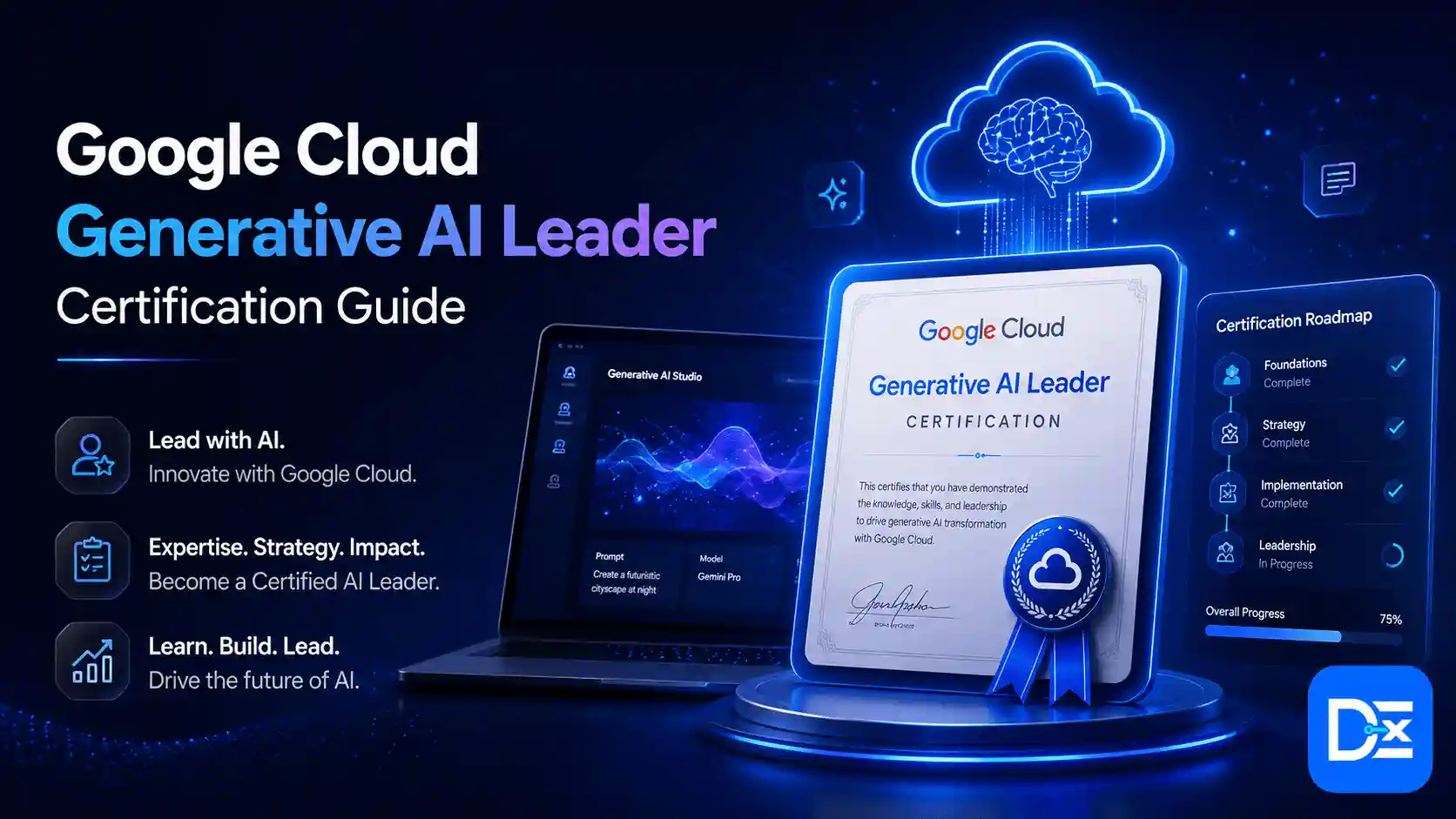
Create a professional 1600 x 900 px WordPress feature image with a dark navy gradient background. Show a Google Cloud style certification dashboard, an exam checklist, gen AI icons, a study plan timeline, and a certificate badge. Keep the design clean, modern, and easy to read.
Suggested File Name:
google-cloud-generative-ai-leader-certification-guide-2026.webp
Suggested Alt Text:
Google Cloud Generative AI Leader certification guide showing exam cost, prerequisites, study plan, and sample topics
Suggested Caption:
A practical guide to the Google Cloud Generative AI Leader certification, exam cost, prerequisites, study plan, and sample topics.
FAQs About Google Cloud Generative AI Leader Certification
1. Is Google Cloud Generative AI Leader good for beginners?
Yes. It has no prerequisites and is suitable for learners with or without hands-on technical experience. However, beginners should study AI basics, Google Cloud gen AI offerings, prompt engineering, RAG, responsible AI, and business strategy before booking the exam.
2. What is the Google Cloud Generative AI Leader exam cost?
The exam fee is $99 plus applicable tax. The final amount can vary by region due to taxes and payment processing, so always check the official Google Cloud certification page before registering.
3. Does the exam require coding?
No. This is not a coding-heavy exam. It focuses on generative AI concepts, Google Cloud AI offerings, model output improvement, secure AI, responsible AI, and business adoption strategy.
4. How long should I study for the exam?
A learner with basic AI knowledge may prepare in 3 to 4 weeks with consistent study. A complete beginner may need more time to understand AI fundamentals, Google Cloud tools, and responsible AI concepts.
5. Does this certification help with jobs?
It can support your resume, especially for AI-adjacent, product, consulting, cloud, and business roles. It does not guarantee a job. Pair it with practical projects, case studies, and interview preparation.
Conclusion
The Google Cloud generative AI leader certification is useful for learners who want a source-backed, business-focused understanding of generative AI and Google Cloud AI offerings. It is beginner-friendly, has no prerequisites, and covers practical topics such as prompt engineering, RAG, secure AI, responsible AI, and business use case selection.
It is not the right certification if you want to prove deep AI engineering ability. For that, you need coding, model work, APIs, evaluation, cloud deployment, and real projects.
The best approach is simple. Read the exam guide, complete the official learning path, study the four exam domains, practice sample questions, build one small AI workflow or business case, and book the exam only when you can explain the topics clearly without relying on memorized notes.