If you are comparing AI course vs AI certification, the first thing to understand is this: both can help, but they solve different problems. An AI course teaches you skills. An AI certification proves that you have completed learning or passed an assessment.
This matters in 2026 because AI learning options are everywhere. Some are short courses for prompt writing. Some teach Python, machine learning, and generative AI projects. Some certifications are exam-based, while others are completion certificates from online platforms.
This guide is for students, beginners, career switchers, working professionals, freelancers, solo founders, IT learners, and non-technical professionals who want a practical AI learning path before spending money.
Quick Answer
Choose an AI course if you need skills, projects, tools, and guided learning. Choose an AI certification if you already understand the basics and want proof of knowledge for your resume or LinkedIn. For most beginners, the best path is course first, project second, certification third. A certificate alone is not enough for AI job readiness.
Who This Guide Is For
This guide is useful for:
- Students exploring AI career options
- Beginners are confused between courses and certifications
- Working professionals who want AI skills for daily work
- Career switchers moving into technology roles
- Freelancers who want to use AI in client work
- Developers who want practical AI and ML skills
- Non-technical professionals in marketing, HR, sales, finance, operations, or product
- Solo founders who want to understand AI tools before hiring technical help
- IT learners planning a future in AI, data science, cloud AI, or automation
AI Course vs AI Certification: What Is the Difference?
| Factor | AI Course | AI Certification |
| Main purpose | Teaches concepts, tools, and practical skills | Validates knowledge or completion |
| Best for | Learning from scratch | Showing proof of learning |
| Includes projects | Often, yes, depending on the provider | Sometimes, but many are exam-based |
| Good for beginners | Yes | Yes, if the certification is beginner-level |
| Resume value | Stronger when projects are included | Useful if the provider is recognized |
| Career support | Depends on the provider | Usually limited unless part of a larger program |
| Cost | Free to premium | Free, paid, or exam-based |
| Best use | Building skill | Supporting credibility |
A simple way to decide: if you cannot explain or apply AI concepts yet, take a course. If you already know the basics and want a credential, take a certification.
How We Selected These Courses, Platforms, and Certifications
Provider credibility: We included options from recognized providers such as Google, AWS, Microsoft, IBM, Google Cloud, and DeepLearning.AI.
Beginner friendliness: We prioritized options that are suitable for beginners or clearly explain who should enroll.
Practical projects: We looked for tools, labs, assignments, projects, or applied work where available.
Tools and skills covered: We considered AI basics, generative AI, prompt engineering, Python, machine learning, LLMs, chatbots, agents, and AI workflow skills.
Certificate value: We checked whether learners receive a certificate, a professional certificate, or an exam-based certification.
Placement or career support: We did not assume placement support unless clearly offered. Most listed options provide learning or certification, not direct placement.
Pricing transparency: We included notes where pricing or subscription models are visible. Learners should verify current pricing before enrolling.
Flexibility and duration: We focused on online and self-paced options suitable for students and working learners.
India and USA relevance: The list is globally useful, but AWS, Microsoft, Google, IBM, and DeepLearning.AI have stronger recognition across India, the USA, and remote tech markets.
Recency and 2026 relevance: We included current AI, generative AI, cloud AI, and workplace AI options. For Microsoft, we noted the AI-900 to AI-901 change.
1. Google AI Professional Certificate | Google via Coursera
Google AI Professional Certificate is a practical AI course-style program for people who want to use AI at work. It focuses on AI fluency, productivity, research, writing, planning, content creation, data analysis, and building useful AI workflows. It is not designed as a deep machine learning engineering program. Instead, it is better for working professionals, students, freelancers, and non-technical learners who want to apply AI tools in daily work. Learners practice with tools such as Gemini, NotebookLM, Gemini in Google Workspace, and Google AI Studio.
- Best For: Working professionals, students, freelancers, and non-technical learners who want applied AI skills.
- Level: Beginner.
- Duration: The official page lists seven courses that can be completed at your own pace, with each course lasting around one hour.
- Mode: Online and self-paced.
- Certificate: A certificate from Google is available after completing the program.
- Career / Placement Support: Career support details should be verified on the official provider page. Do not treat this as a placement program.
Skills Covered:
- AI productivity workflows
- Prompt writing
- Research and planning with AI
- Content creation
- Data analysis support
- AI-assisted coding basics
- Responsible AI use
- Custom AI tool building basics
Tools Covered:
- Gemini
- NotebookLM
- Gemini in Google Workspace
- Google AI Studio
- Browser-based generative AI tools
Projects / Practical Learning:
The program includes practical activities and workplace-style outputs. Learners can create useful portfolio assets such as AI research workflows, content plans, spreadsheet analysis examples, and simple AI tools.
What Sets It Apart:
- Strong fit for workplace AI skills
- Beginner-friendly with no AI experience required
- Useful for non-technical and semi-technical roles
Who Should Choose This:
Choose this if you want to use AI better at work, improve productivity, and build practical AI outputs without starting with coding.
Who Should Avoid This:
Avoid this if your goal is to become a machine learning engineer or AI researcher. You will need Python, math, ML, and model building beyond this.
Digital Exclude Verdict:
This is a good AI course choice for practical users. It has better value when learners create real examples from their own work, not just complete the lessons.
Last Verified: June 2026.
2. AI For Everyone | DeepLearning.AI via Coursera
AI For Everyone is a beginner-friendly AI course for people who need to understand artificial intelligence without becoming developers. It explains AI terminology, machine learning, deep learning, data, AI project workflows, AI strategy, and ethical questions. It is useful for managers, founders, students, business professionals, and non-technical learners who want clarity before choosing a technical AI learning path. It is not a coding course, but it gives learners the language needed to work with AI teams and evaluate AI use cases.
- Best For: Non-technical professionals, founders, managers, students, and complete beginners.
- Level: Beginner.
- Duration: The course has 4 modules. Module durations are listed on the official course page.
- Mode: Online and self-paced.
- Certificate: A course certificate is available through Coursera after completion, depending on enrollment type.
- Career / Placement Support: Career support details should be verified on the official provider page.
Skills Covered:
- AI terminology
- Machine learning basics
- Deep learning basics
- Data science awareness
- AI project workflow
- AI strategy
- Responsible AI and ethics
- Working with AI teams
Tools Covered:
- No major coding tool is required
- Conceptual AI project planning
Projects / Practical Learning:
This course is more conceptual than project-based. Learners should add a small AI use case plan, prompt workflow, or business AI case study after completing it.
What Sets It Apart:
- Clear for non-technical learners
- Useful before choosing a paid AI program
- Helps learners understand what AI can and cannot do
Who Should Choose This:
Choose this if you are new to AI and want a practical foundation before choosing technical courses.
Who Should Avoid This:
Avoid this if you already know AI basics and want hands-on coding, model training, or deployment projects.
Digital Exclude Verdict:
AI For Everyone is a smart first AI course for non-technical learners. It will not make you job-ready alone, but it can prevent poor course choices later.
Last Verified:
June 2026.
3. IBM AI Developer Professional Certificate | IBM via Coursera
IBM AI Developer Professional Certificate is a more technical AI course path for learners who want to build AI-powered applications. It covers AI concepts, generative AI, chatbots, Python, Flask, app development, and deployment-related skills. It is suitable for beginners who are ready to become technical, but it needs more time and consistency than a short certificate. If you want to move from “I understand AI” to “I can build something with AI,” this type of course is more useful than a simple exam credential.
- Best For: Aspiring AI developers, Python beginners, and learners who want AI app projects.
- Level: Beginner to intermediate.
- Duration: The official page mentions around 6 months.
- Mode: Online and self-paced.
- Certificate: An IBM professional certificate is available after completing the program requirements.
- Career / Placement Support: Career support details should be verified on the official provider page.
Skills Covered:
- AI fundamentals
- Generative AI concepts
- Python basics
- Flask web app development
- AI-powered chatbots
- AI app workflows
- Model and API usage
- Web deployment basics
Tools Covered:
- Python
- Flask
- IBM AI tools and learning environment
- Chatbot frameworks and AI services, depending on the course module
Projects / Practical Learning:
This program includes hands-on assignments and AI application work. Learners can use projects as portfolio examples if they document the problem, tools, architecture, and output clearly.
What Sets It Apart:
- More technical than general AI literacy courses
- Useful for AI app building
- Better for portfolio development than theory-only certifications
Who Should Choose This:
Choose this if you want to build AI applications and are willing to learn Python and web basics.
Who Should Avoid This:
Avoid this if you only need AI awareness for business tasks or do not want coding.
Digital Exclude Verdict:
This is closer to a real AI learning path than a simple certificate. It is useful for beginners who want technical practice, but learners should still build independent projects beyond course assignments.
Last Verified: June 2026.
4. IBM Generative AI Engineering Professional Certificate | IBM via Coursera
IBM Generative AI Engineering Professional Certificate is aimed at learners who want to build generative AI applications, agents, chatbots, and LLM-based workflows. It includes topics such as machine learning, deep learning, NLP, prompt engineering, model training, fine-tuning, Python libraries, and GenAI application development. It is more technical than a general AI certificate and better suited for learners who want engineering depth. Beginners can start, but they should be ready for coding and practice.
- Best For: Learners who want to build GenAI apps, LLM workflows, chatbots, and AI agents.
- Level: Beginner to intermediate.
- Duration: The official page mentions around 6 months.
- Mode: Online and self-paced.
- Certificate: An IBM professional certificate is available after completing the program requirements.
- Career / Placement Support: Career support details should be verified on the official provider page.
Skills Covered:
- Generative AI concepts
- Prompt engineering
- LLM workflows
- NLP applications
- Machine learning basics
- Deep learning basics
- AI agents and chatbots
- Python-based AI development
Tools Covered:
- Python
- Flask
- SciPy
- Scikit-learn
- Keras
- PyTorch
- AI chatbot and agent workflows, depending on the module
Projects / Practical Learning:
The program includes applied work around GenAI apps, chatbots, and AI workflows. Learners should convert assignments into portfolio case studies with screenshots, GitHub notes, and problem statements.
What Sets It Apart:
- Stronger focus on GenAI engineering
- Includes coding and practical AI workflows
- Useful for learners moving beyond prompt usage
Who Should Choose This:
Choose this if your goal is to build AI applications, not just use AI tools.
Who Should Avoid This:
Avoid this if you are a complete non-technical learner who wants only workplace productivity skills.
Digital Exclude Verdict:
This is a better fit for future AI builders than casual AI users. It has a stronger project value than exam-only certifications, but it needs commitment.
Last Verified: June 2026.
5. AWS Certified AI Practitioner | AWS
AWS Certified AI Practitioner is an exam-based AI certification for people who want to show foundational knowledge of AI, machine learning, generative AI, and AWS AI services. It is designed for people familiar with AI concepts, but not necessarily building full AI systems. This certification is useful for cloud learners, technical sales teams, product professionals, business users, and early IT learners who want AI plus cloud credibility. It validates knowledge, but it does not replace hands-on AI development practice.
- Best For: Cloud beginners, AWS learners, IT professionals, product teams, and business professionals working on AI projects.
- Level: Beginner.
- Duration: The exam duration is 90 minutes.
- Mode: Online proctored exam or test center exam.
- Certificate: AWS certification is available after passing the exam.
- Career / Placement Support: No placement support is clearly mentioned.
Skills Covered:
- AI concepts
- Machine learning basics
- Generative AI basics
- Responsible AI
- AWS AI services
- Business use cases for AI
- AI and ML strategy awareness
Tools Covered:
- AWS AI and ML services at a conceptual level
- AWS certification preparation resources
Projects / Practical Learning:
The certification is exam-based. To make it practical, learners should add AWS hands-on practice, such as testing Amazon Bedrock, using AI services, building a basic AI chatbot, or documenting an AI workflow.
What Sets It Apart:
- Recognized AWS certification
- Good for cloud plus AI learners
- Useful for non-builders who work around AI systems
Who Should Choose This:
Choose this if you are already interested in AWS or want AI knowledge connected with cloud services.
Who Should Avoid This:
Avoid this if you want a course that teaches coding step by step. It validates knowledge more than it teaches project skills.
Digital Exclude Verdict:
AWS Certified AI Practitioner has good certificate value for cloud-focused learners. Pair it with hands-on AWS AI projects to make it meaningful on a resume.
Last Verified: June 2026.
6. Microsoft Certified: Azure AI Fundamentals | Microsoft
Microsoft Certified: Azure AI Fundamentals is a beginner certification for learners who want to understand AI workloads and Azure AI services. It covers AI concepts, machine learning, computer vision, NLP, generative AI, and responsible AI ideas within the Microsoft Azure ecosystem. A key 2026 update is important: Exam AI-900 is scheduled to retire on June 30, 2026, and Microsoft has introduced AI-901 as the replacement exam path. Learners should verify the latest exam requirements before booking.
- Best For: Azure beginners, Microsoft ecosystem learners, students, and IT professionals exploring AI.
- Level: Beginner.
- Duration: Check the official Microsoft page for the latest AI-901 exam duration and requirements.
- Mode: Online proctored exam or test center exam, depending on current Microsoft exam options.
- Certificate: Microsoft certification is available after passing the required exam.
- Career / Placement Support: Career support details should be verified on the official provider page.
Skills Covered:
- AI workloads
- Machine learning concepts
- Computer vision basics
- Natural language processing
- Generative AI concepts
- Azure AI services
- Responsible AI principles
Tools Covered:
- Microsoft Azure AI services
- Microsoft Learn resources
Projects / Practical Learning: The certification is knowledge-focused. Learners should add Azure AI Studio practice, simple text analysis, image analysis, chatbot experimentation, or Azure AI service demos.
What Sets It Apart:
- Strong fit for Microsoft and Azure learners
- Beginner-friendly AI certification
- Useful for students and enterprise IT professionals
Who Should Choose This: Choose this if your target companies use Azure or Microsoft tools.
Who Should Avoid This: Avoid booking without checking the current AI-900 and AI-901 status. The exam transition matters in 2026.
Digital Exclude Verdict:
Azure AI Fundamentals is valuable for Microsoft-aligned learners. Because of the exam change, check Microsoft’s official page before planning your study timeline.
Last Verified: June 2026.
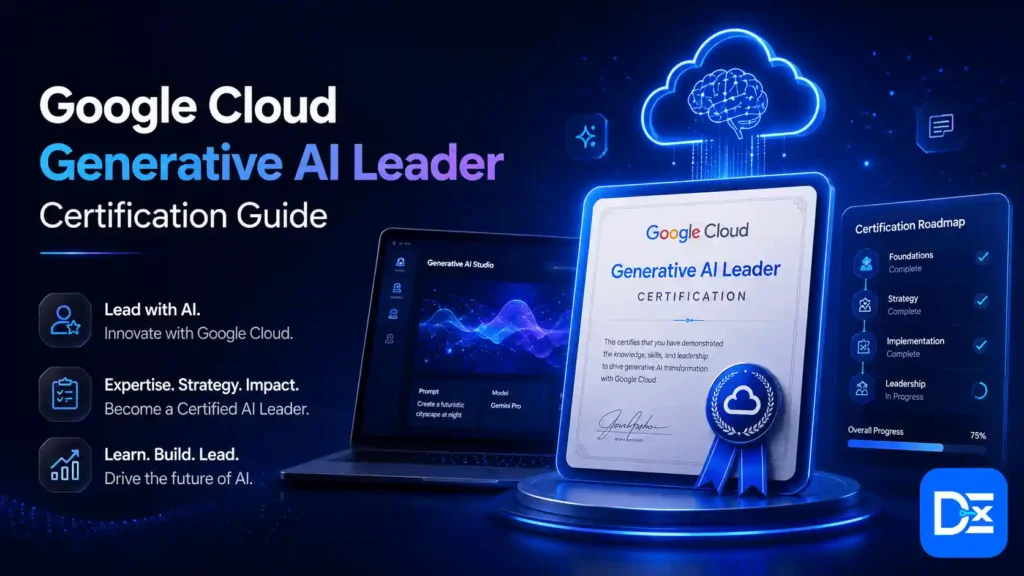
7. Google Cloud Generative AI Leader | Google Cloud
Google Cloud Generative AI Leader is an exam-based certification for learners who want to show understanding of generative AI concepts, Google Cloud AI capabilities, responsible AI, and business use cases. It is suitable for product managers, business leaders, consultants, cloud professionals, and AI-curious learners who need credibility in GenAI conversations. It is not a deep engineering course, so learners who want to build LLM apps should add labs, coding, and deployment practice.
- Best For: Business professionals, cloud learners, product teams, and GenAI strategy learners.
- Level: Beginner.
- Duration: The exam duration is 90 minutes.
- Mode: Online proctored exam or onsite proctored exam.
- Certificate: Google Cloud certification is available after passing the exam.
- Career / Placement Support: No placement support is clearly mentioned.
Skills Covered:
- Generative AI fundamentals
- Google Cloud AI concepts
- Business use cases
- Responsible AI
- AI adoption planning
- GenAI terminology
- AI risk awareness
Tools Covered:
- Google Cloud AI concepts
- Google Cloud learning resources
- GenAI exam preparation materials
Projects / Practical Learning:
The exam validates knowledge. Learners should add projects such as a Gemini-powered workflow, document summarization demo, customer support chatbot plan, or Google Cloud AI lab.
What Sets It Apart:
- Focused on GenAI leadership and business use
- Recognized Google Cloud credential
- Useful for non-engineering AI roles
Who Should Choose This:
Choose this if you want a GenAI certification connected to Google Cloud and business adoption.
Who Should Avoid This:
Avoid this if your main goal is hands-on model training, Python development, or AI engineering.
Digital Exclude Verdict:
Google Cloud Generative AI Leader is useful for business and cloud professionals. It works best when paired with real GenAI experiments or workplace AI projects.
Last Verified: June 2026.
Best Option by Learner Type
| Learner Type | Best Option | Why |
| Best for complete beginners | AI For Everyone | Clear AI basics without coding pressure |
| Best for students | Google AI Professional Certificate | Practical AI skills and beginner friendly structure |
| Best for working professionals | Google AI Professional Certificate | Helps apply AI in daily work |
| Best with placement support | Verify provider claims | Most listed options do not clearly provide placement support |
| Best for India | Google, IBM, AWS, Microsoft options | Recognized brands are useful for resumes |
| Best for USA | Google, AWS, Microsoft, IBM options | Stronger employer familiarity |
| Best for non-technical professionals | AI For Everyone or Google AI Professional Certificate | Good for AI literacy and workplace use |
| Best for developers | IBM AI Developer or IBM Generative AI Engineering | More hands-on and technical |
| Best for low-budget learners | AI For Everyone, or free audit options where available | Good for testing interest before paying |
| Best for portfolio projects | IBM AI Developer or IBM Generative AI Engineering | Better project potential |
| Best for certification value | AWS Certified AI Practitioner, Azure AI Fundamentals, Google Cloud Generative AI Leader | Exam-based credentials from major cloud providers |
AI Learning Path: Course First or Certification First?
Step 1: Learn AI Fundamentals
Start with AI basics, machine learning, deep learning, generative AI, NLP, computer vision, AI ethics, and limitations. Do not start with advanced model training if you cannot explain basic AI terms.
Step 2: Learn Core Tools
Depending on your goal, learn tools such as:
- ChatGPT or Gemini
- NotebookLM
- Google AI Studio
- Python
- Jupyter Notebook
- Pandas
- Scikit-learn
- PyTorch or TensorFlow
- Azure AI services
- AWS AI services
- Google Cloud AI tools
Step 3: Build Small Projects
Create small but explainable projects:
- Resume screening assistant
- Customer review classifier
- AI study planner
- Chatbot for FAQs
- Document summarizer
- Image classification demo
- AI content workflow
- Sales email assistant
- RAG-based knowledge assistant
Step 4: Earn a Certificate or Certification
After you build a basic understanding, choose a certificate that matches your goal. Use course certificates for learning proof and exam certifications for stronger credential validation.
Step 5: Prepare Resume and Portfolio
Add your certificate, but also include:
- Project screenshots
- GitHub links
- Use case explanation
- Tools used
- Problem solved
- Limitations
- What would you improve next
Step 6: Apply for Internships, Freelance Projects, or Jobs
Start with realistic opportunities. Look for AI intern, junior data analyst, automation assistant, prompt workflow specialist, AI content operations, AI support, or junior developer roles, depending on your skill level.
How to Judge Placement and Career Support Honestly
Placement support is not the same as guaranteed job placement. A provider may offer resume guidance or interview preparation, but that does not mean every learner will get a job.
Before choosing an AI course, check whether the provider clearly offers:
- Resume reviews
- Mock interviews
- Career coaching
- Hiring partner access
- Job boards
- Referrals
- Portfolio review
- Capstone projects
- Interview preparation
- Live mentor support
Verify every claim on the official provider page. If a page only says “career support,” check what that includes. Does it include resume feedback? Does it include interview practice? Does it include hiring partner access? Does it include real projects?
Do not choose a course only because it says “job-ready.” Choose it because the skills, tools, projects, and support match your actual goal.
Free vs Paid AI Course Guidance
Free courses are good for the basics. If you are new to AI, start with free or low-cost learning before paying for a long program. Learn AI terms, prompt basics, common tools, and simple use cases first.
Paid courses may help when you need structure, projects, graded assignments, mentorship, certificates, and career support. A paid course can be useful if you struggle to stay consistent or need a clear path.
Beginners should avoid expensive programs until they understand their career goal. If you do not know whether you want AI for business, AI development, data science, or cloud AI, complete a short beginner course first.
Common Mistakes to Avoid
Choosing Only by Brand Name
A big provider name helps, but the course still needs to match your goal. A workplace AI course will not prepare you for ML engineering by itself.
Ignoring Projects
Certificates are helpful, but projects show application. Build at least two small projects before applying for AI roles.
Believing Job Claims Without Verification
Do not assume placement support. Check official provider pages for resume support, interview practice, hiring partners, and career services.
Choosing Advanced Courses Without the Basics
Do not start with deep learning, fine-tuning, or agents if you do not know Python, AI fundamentals, and prompt basics.
Ignoring Time Commitment
A 6-month program needs weekly consistency. A short certificate may be easy to finish, but it may not build deep skill.
Not Checking Certificate Recognition
Some certificates are completion certificates. Some are exam-based certifications. Employers may treat them differently.
Not Building a Portfolio
A certificate without proof of work is weak. Add screenshots, GitHub notes, demos, and short case studies.
Not Comparing India and USA Career Expectations
In India, many entry-level AI roles expect Python, SQL, basic ML, and projects. In the USA, AI adjacent roles may also expect portfolio proof, tool fluency, and business communication. In both markets, certificates help more when backed by work samples.
FAQs About AI Course vs AI Certification
Is an AI course better than an AI certification for beginners?
An AI course is usually better for beginners because it teaches concepts, tools, and projects. A certification is better after you already understand the basics and want proof of learning.
Does an AI certificate have value?
Yes, an AI certificate has value when it comes from a credible provider and supports real skills. Its value is much stronger when you also have projects, practical examples, and tool experience.
Can non-technical learners start with AI courses?
Yes. Non-technical learners can start with AI literacy, prompt writing, workplace AI tools, and responsible AI. They do not need to start with Python or machine learning math immediately.
Which is better for jobs, AI course or AI certification?
For jobs, skills, and projects matter more than the certificate alone. A good AI course helps you build skills, while a certification supports credibility. The best option is to combine both with a portfolio.
Should I choose free or paid AI courses?
Start with free or low-cost AI courses if you are exploring. Choose a paid course only when you know your goal and need structure, projects, mentorship, career support, or a recognized certificate.
Conclusion
The AI course vs AI certification decision is not really about choosing one forever. It is about choosing the right step for your current stage. If you are new, start with a course. If you already understand AI basics, add a certification. If you want career growth, build projects and document your work.
For most beginners in 2026, the best path is simple: learn AI fundamentals, practice with tools, build small projects, then earn a certificate or certification that matches your target role.
A certificate can support your profile, but it cannot replace skills. Choose the option that helps you learn, build, and explain what you can actually do with AI.