AI and LLM
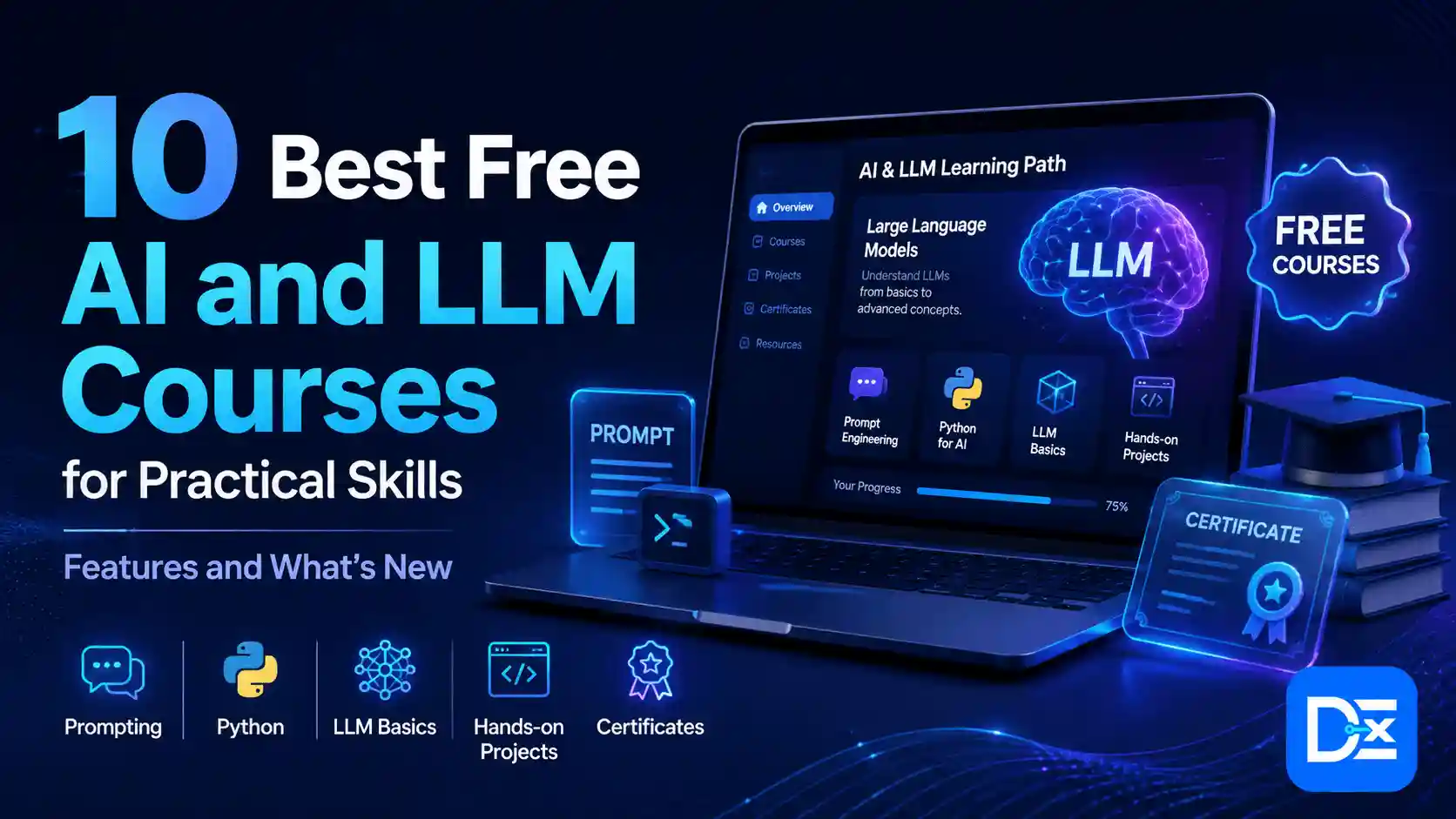
There is no shortage of free AI courses.
The difficult part is deciding which one deserves your time.
A quick search can lead you to hundreds of courses covering artificial intelligence, machine learning, generative AI, large language models, prompt engineering, RAG, AI agents, fine-tuning, and deep learning.
Some are excellent. Some are outdated. Some are called “free” even though only the first lesson is available without payment. Others explain concepts well but leave you with no idea what to build afterward.
That is the problem this guide is designed to solve.
Instead of giving you another list of course names, we compare free AI and LLM courses based on four questions:
- What will you actually learn?
- How practical is the course?
- What can you build after completing it?
- How can the skill solve a real career or business problem?
That last question matters.
AI adoption is no longer limited to research teams. Stanford’s AI Index reported that the share of surveyed organizations using AI increased from 55% in 2023 to 78% in 2024. Generative AI use in at least one business function also increased from 33% to 71%.
The World Economic Forum reports that employers expect 39% of key job skills to change by 2030, with technology skills growing in importance particularly quickly.
The lesson is not that everyone needs to become an AI engineer.
The lesson is that knowing how to use, evaluate, build, or manage AI systems is becoming useful across more jobs and businesses.
If you are completely new to the field, you can also start with Digital Exclude’s Artificial Intelligence Course Guide before choosing a more specialized path.
Course verification note: Course access, curricula, badges, API requirements, and certificate policies can change. We link directly to official providers throughout this guide so you can verify the current terms before enrolling.
Quick Answer: Which Free AI Course Should You Choose?
Use your goal, not the provider’s brand name, to choose a course.
| Your Goal | Best Starting Point |
| Learn AI from zero | IBM SkillsBuild Artificial Intelligence Fundamentals |
| Understand generative AI and LLMs | Google Introduction to Generative AI Learning Path |
| Learn machine learning fundamentals | Google Machine Learning Crash Course |
| Build a strong Python-based AI foundation | Harvard CS50 AI |
| Study deep learning | MIT 6.S191 |
| Understand Transformers and open-source LLMs | Hugging Face LLM Course |
| Build RAG and production-oriented LLM applications | LLM Zoomcamp |
| Learn fine-tuning and LLM engineering | Maxime Labonne’s LLM Course |
| Improve prompting and AI evaluation | Anthropic Educational Courses |
| Learn deep learning through projects | fast.ai Practical Deep Learning for Coders |
Best for complete beginners: IBM SkillsBuild
Best for developers building LLM apps: LLM Zoomcamp
Best for open-source LLM learning: Hugging Face LLM Course
Best for deep technical foundations: MIT 6.S191
Best for prompt engineering and evaluation: Anthropic Educational Courses
Best for machine learning fundamentals: Google Machine Learning Crash Course
What Does “Free AI Course” Actually Mean?
This is one of the biggest problems with AI course roundups.
“Free” can mean several different things.
Fully Free Learning Material
You can access the complete educational material without paying tuition.
You may still incur optional costs for API usage, cloud computing, GPUs, or external services while completing projects.
Free Course With a Free Credential
Some platforms provide both the learning material and a completion badge or certificate without a course fee.
IBM SkillsBuild, for example, offers verified digital credentials for eligible learning plans, including Artificial Intelligence Fundamentals.
Free Content With Paid Labs or Certificates
Some providers let you watch videos and read course materials without payment but charge for hands-on labs, credits, examinations, subscriptions, or verified certificates.
Google Cloud Skills Boost explicitly notes that many course videos and documents can be consumed for free, while some labs can require credits or a subscription.
That distinction matters.
A course should not be described as completely free simply because the enrollment button says “start for free.”
If obtaining a credential is your main goal, see our separate guide to free AI courses with certificate options.
How We Evaluated These Free AI and LLM Courses
A well-known provider does not automatically make a course useful.
We focused on factors that affect what the learner can actually do afterward.
Curriculum Relevance
We looked for useful coverage of topics such as:
- Artificial intelligence fundamentals
- Machine learning
- Deep learning
- Generative AI
- Large language models
- Transformers
- Embeddings
- Prompt engineering
- Retrieval-augmented generation
- AI agents
- Fine-tuning
- Evaluation
- Responsible AI
Practical Learning
A video can explain RAG.
Building a retrieval system teaches you what happens when chunking is poor, search results are irrelevant, prompts fail, or an answer cannot be supported by the knowledge base.
We therefore give more weight to courses with:
- Coding exercises
- Notebooks
- Labs
- Projects
- Model training
- APIs
- Retrieval pipelines
- Evaluations
- Deployment exercises
- Capstone projects
Business Usefulness
The most important question is not:
“Does this course teach embeddings?”
A better question is:
“What problem can I solve after understanding embeddings?”
Embeddings can support semantic search, recommendations, retrieval, document matching, clustering, and other practical applications.
That context turns technical knowledge into useful capability.
Beginner Accessibility
We also consider the real prerequisites.
A course labeled “beginner” may still expect Python, command-line experience, APIs, statistics, calculus, or Docker.
We point those requirements out instead of assuming all beginners start from the same place.
Learning Outcome
Finally, we ask:
What should a realistic learner be able to understand or build after completing the course?
Completing a short introductory course does not make someone an AI engineer.
A useful course guide should say that clearly.
Best Free AI and LLM Courses Compared
| Course | Level | Free Access | Hands-On Level | Best For |
| IBM Artificial Intelligence Fundamentals | Beginner | Free | Medium | Complete beginners |
| Google Generative AI Learning Path | Beginner | Free learning available | Medium | GenAI fundamentals |
| Google Machine Learning Crash Course | Beginner to Intermediate | Free | High | ML foundations |
| Harvard CS50 AI | Intermediate | Free | Very High | Python developers |
| MIT 6.S191 | Intermediate | Free course materials | High | Deep learning |
| Hugging Face LLM Course | Intermediate | Free | High | Open-source LLMs |
| LLM Zoomcamp | Intermediate | Free | Very High | RAG and LLM applications |
| Maxime Labonne LLM Course | Intermediate to Advanced | Free | High | LLM engineering |
| Anthropic Educational Courses | Beginner to Intermediate | Free materials | High | Prompting and evaluation |
| fast.ai Practical Deep Learning | Intermediate | Free | Very High | Project-first deep learning |
1. IBM SkillsBuild Artificial Intelligence Fundamentals
IBM SkillsBuild Artificial Intelligence Fundamentals is one of the easiest places to begin if you want structured AI education without jumping directly into Python or complex mathematics.
IBM lists Artificial Intelligence Fundamentals as a 10+ hour credential covering natural language processing, computer vision, machine learning, deep learning, neural networks, chatbots, AI ethics, and common AI applications.
What You Will Learn
The course builds vocabulary and conceptual understanding across major areas of AI.
You will encounter topics such as:
- Machine learning
- Deep learning
- NLP
- Computer vision
- Neural networks
- Chatbots
- Responsible AI
- AI careers and applications
Who Should Take It?
This is a good option for:
- Students
- Career switchers
- Business professionals
- Non-technical learners
- Beginners exploring AI careers
- Learners who want an IBM digital credential
What Can You Do After Completing It?
A realistic outcome is AI literacy.
You should understand what common AI technologies do, where they are useful, and which area you might want to study next.
For example, a marketing professional should be better equipped to distinguish between a generative AI writing workflow, a predictive machine learning problem, and a chatbot use case.
That is valuable even if that person never trains a model.
What It Does Not Teach Deeply
You will need additional learning for:
- Production RAG
- AI agents
- Advanced Python
- Fine-tuning
- LLM evaluation
- Model deployment
- AI application architecture
Digital Exclude Verdict
Best for beginners who want structured fundamentals before specializing.
Do not treat the credential as proof that you are ready for an AI engineering role. Use it to establish your foundation, then build something.
2. Google Introduction to Generative AI Learning Path
Google Cloud’s Introduction to Generative AI Learning Path is a useful option if your immediate goal is understanding generative AI rather than studying the full history of artificial intelligence.
The learning path includes activities covering generative AI, large language models, responsible AI, prompt design, and practical Google Cloud concepts.
What You Will Learn
The path introduces:
- Generative AI
- LLM fundamentals
- Prompt design
- Responsible AI
- Multimodal AI concepts
- Google Cloud AI tooling
Who Should Take It?
It works well for:
- Complete GenAI beginners
- Product managers
- Marketers
- Business professionals
- Consultants
- Developers exploring Google’s AI stack
- Teams evaluating Gemini and Vertex AI
What Can You Do With the Knowledge?
For a non-technical professional, the biggest benefit is learning how to frame and improve AI-assisted work.
For a developer, it provides a short introduction before moving into APIs, RAG, model evaluation, or Vertex AI development.
For a business manager, it can help with evaluating potential AI use cases without beginning with complex ML theory.
Important Cost Detail
Google makes many learning materials available without charge, but some hands-on labs can require credits or subscription access. Check the activity requirements before starting a path that contains labs.
Digital Exclude Verdict
Best for learners who want a fast introduction to generative AI and Google’s AI ecosystem.
It is a starting point, not an LLM engineering curriculum.
3. Google Machine Learning Crash Course
The Google Machine Learning Crash Course is a better fit when you want to understand why AI systems behave the way they do.
It covers foundational machine learning topics, including concepts that become highly relevant when you later study LLM systems.
For example, Google’s dedicated embeddings module teaches how dense vector representations capture useful relationships between data points, which is foundational to semantic retrieval and many RAG systems.
What You Should Learn
Useful areas include:
- Regression
- Classification
- Neural networks
- Model training
- Overfitting
- Validation
- Embeddings
- Data quality
- Evaluation
- Responsible machine learning
Why Learn Machine Learning When LLM APIs Already Exist?
Because an API can hide complexity.
You may successfully call an LLM without knowing anything about machine learning.
The problem starts when your system fails.
Understanding training, evaluation, representations, data quality, and model behavior gives you better tools for diagnosing those failures.
Business Use Case
Imagine an ecommerce company trying to identify which customer support messages represent:
- Refund requests
- Product issues
- Delivery complaints
- Sales questions
- Fraud concerns
An LLM could do the classification.
A traditional machine learning model could also potentially solve the problem.
Understanding both approaches helps you choose based on cost, accuracy, volume, latency, and maintenance rather than assuming the newest model is automatically best.
Digital Exclude Verdict
One of the strongest free foundations for people who want to understand AI systems rather than only use AI tools.
4. Harvard CS50’s Introduction to Artificial Intelligence With Python
CS50’s Introduction to Artificial Intelligence with Python is a strong option for developers who want broad AI fundamentals backed by serious programming assignments.
The course covers search, knowledge, uncertainty, optimization, machine learning, neural networks, and language. Harvard recommends CS50x or roughly a year of Python experience before taking it.
What Makes CS50 AI Different?
Many newer AI courses begin with prompts and model APIs.
CS50 begins deeper.
You learn how systems can search, reason, represent information, work with uncertainty, optimize decisions, and learn from data.
That breadth is valuable because not every software problem needs an LLM.
Practical Learning
The course uses Python projects rather than relying only on lectures.
That makes it particularly useful for developers who learn by implementing concepts.
Certificate
Learners who meet CS50’s required project scores can qualify for a free CS50 Certificate. A separate verified edX credential is available through a paid route.
Business Use Case
Suppose you are designing an AI-powered product recommendation feature.
Understanding search, probability, classification, and optimization gives you more architectural choices than starting with:
“Which LLM should we use?”
Good AI engineering begins with the problem.
Digital Exclude Verdict
Best for Python developers who want durable artificial intelligence fundamentals and meaningful project work.
If you only want to build a simple RAG prototype quickly, this course may be broader than necessary.
5. MIT 6.S191 Introduction to Deep Learning
MIT 6.S191 Introduction to Deep Learning is one of the strongest options for technical learners who want to understand neural networks and modern deep learning more seriously.
MIT makes lecture materials, slides, and software labs available online. Its course materials have covered deep sequence modeling, computer vision, generative modeling, and practical deep learning exercises.
Who Should Take It?
Consider MIT 6.S191 if you are:
- A developer
- An engineering student
- An ML learner
- A researcher
- Comfortable with technical material
- Interested in what happens below the API layer
What Can You Learn?
Depending on the current edition, the course can provide exposure to:
- Neural networks
- Deep learning
- Sequence models
- Computer vision
- Generative models
- Model training
- Practical Python labs
Business Use Case
Not every organization needs to train custom deep learning models.
But some problems involve:
- Images
- Specialized predictions
- Domain-specific classification
- Recommendations
- Complex sequential data
- Model research
Understanding deep learning helps technical teams evaluate when custom model work makes sense and when an existing API is the more economical option.
What It Does Not Do
This is not a workplace AI productivity course.
If neural networks, tensors, gradients, and Python are completely unfamiliar, start with a simpler foundation first.
Digital Exclude Verdict
Best for serious technical learners who want to understand the deep learning layer underneath modern AI.
6. Hugging Face LLM Course
The Hugging Face LLM Course is one of the most useful free resources for developers who want to understand large language models through the open-source AI ecosystem.
Hugging Face states that the course is completely free and covers LLMs and NLP using Transformers, Datasets, Tokenizers, Accelerate, and the Hugging Face Hub.
What You Will Learn
Topics include:
- Transformers
- Tokenization
- Model inference
- Datasets
- Pretrained models
- Fine-tuning
- Training
- NLP tasks
- Model sharing
- LLM workflows
The course also teaches practical model fine-tuning using Hugging Face tooling.
Who Should Take It?
Best suited to:
- Python developers
- Machine learning students
- Aspiring LLM engineers
- Open-source AI developers
- Researchers
- Developers who want more control over models
What Can You Build?
Useful portfolio projects include:
- Sentiment classifiers
- Text categorization systems
- Summarization tools
- Question-answering applications
- Fine-tuned models
- Model demos
- Domain-specific NLP tools
Business Use Case
Consider a support organization processing thousands of customer messages.
One option is sending every message to a large proprietary LLM.
Another is training or fine-tuning a smaller model for a narrow classification task.
If the smaller model reaches acceptable quality, it may provide advantages in cost, speed, or control.
The point is not that one method is always better.
The value is knowing you have options.
Digital Exclude Verdict
Our strongest recommendation for developers who want to understand open-source LLMs beyond prompt writing.
Pair it with a production application course if your goal is deploying complete AI products.
7. LLM Zoomcamp by DataTalks.Club
LLM Zoomcamp is one of the most practical free courses on this list.
It focuses on building real LLM applications using RAG, vector search, embeddings, function calling, AI agents, evaluation, monitoring, hybrid search, reranking, and an end-to-end project.
Who Should Take It?
It is particularly well suited to:
- Software engineers
- Python developers
- Data engineers
- ML practitioners
- Technical founders
- Developers building AI SaaS products
The course expects Python and command-line familiarity. Basic Docker knowledge helps, while prior ML expertise is not required.
Why LLM Zoomcamp Is Different
Many LLM courses stop after:
- Send a prompt.
- Receive an answer.
- Build a basic chatbot.
Real AI applications have more problems.
You need to ask:
- Did retrieval find the correct information?
- How do we measure answer quality?
- What happens when information is missing?
- How do we monitor the application?
- How do users give feedback?
- How do we combine different search approaches?
LLM Zoomcamp directly teaches evaluation and monitoring rather than treating a successful demo as the end of the project.
What Can You Build?
The capstone structure supports projects such as:
- Internal knowledge assistants
- Customer support assistants
- Technical documentation search
- Product information assistants
- Research tools
- Education assistants
- Codebase Q&A systems
A Real Business Example
Imagine a software company with hundreds of help-center articles.
Customers repeatedly ask questions already answered in the documentation.
A RAG application could:
- Search the approved documentation.
- Retrieve relevant passages.
- Give those passages to the LLM.
- Generate a grounded response.
- Log the interaction.
- Collect user feedback.
- Escalate unsupported questions.
Now the AI system is connected to a business process.
That is substantially more valuable than another generic chatbot demo.
If you want to go further into agent architecture, Digital Exclude’s tutorial on building a multi-agent system in Python provides a practical next project.
Digital Exclude Verdict
Best free option on this list for developers who want to build real-world LLM applications.
8. Maxime Labonne’s LLM Course
Maxime Labonne’s LLM Course is better described as a technical LLM roadmap than a conventional online course.
It is organized into three broad paths:
- LLM Fundamentals
- LLM Scientist
- LLM Engineer
The fundamentals path covers background knowledge, the scientist path focuses more heavily on model building and improvement, and the engineer path focuses on LLM applications and deployment. The author states that the course will remain free.
What You Can Learn
The roadmap reaches topics including:
- Transformer architecture
- Tokenization
- Fine-tuning
- Quantization
- Model evaluation
- LLM datasets
- Model merging
- Open-source models
- Deployment
- LLM application development
Who Should Take It?
Best for:
- ML learners
- LLM engineers
- Researchers
- Developers interested in fine-tuning
- Developers experimenting with local models
- Learners who already understand basic AI concepts
When Does Fine-Tuning Make Business Sense?
Fine-tuning is frequently recommended when a simpler solution would work.
If your problem is:
“The model doesn’t know our private documents.”
You may have a retrieval problem.
If your problem is:
“We want the model to perform a specialized task or consistently behave in a particular way.”
Fine-tuning may deserve investigation.
The course helps expose learners to those model-level techniques rather than limiting AI development to API calls.
What Can You Build?
Potential projects include:
- Fine-tuned open-source models
- Quantized local models
- Domain-specific assistants
- LLM evaluation experiments
- Customized inference pipelines
- Open-source LLM applications
Digital Exclude Verdict
Best suited to learners who have moved beyond AI basics and want to understand LLM engineering at a deeper technical level.
9. Anthropic Educational Courses
Anthropic maintains a collection of educational AI courses covering API fundamentals, prompt engineering, real-world prompting, prompt evaluations, and tool use.
This is important because effective AI application development requires more than writing clever prompts.
What You Can Learn
The prompting material covers concepts such as:
- Prompt structure
- Clear instructions
- Examples
- Output formatting
- Complex prompts
- Hallucination reduction
- Prompt chaining
- Search and retrieval
- Tool use
Anthropic’s interactive prompt engineering material includes nine chapters with exercises.
Why Evaluation Is More Important Than Prompt Tricks
Suppose you create a prompt that summarizes sales calls.
You test it three times.
The results look good.
Is it ready for your sales team?
Not necessarily.
You need an evaluation set that asks whether the output consistently captures:
- Customer problem
- Budget
- Product interest
- Objections
- Decision-maker
- Follow-up action
- Important dates
Anthropic provides separate material on human-graded, code-graded, classification, and model-graded evaluations.
That mindset is critical for businesses.
Production AI needs measurement, not just good-looking examples.
Who Should Take These Courses?
Best for:
- Developers
- Product teams
- Automation professionals
- Technical marketers
- SaaS teams
- Teams using Claude
- Anyone building repeatable prompt workflows
For developers interested in using Claude during software development, see our Claude Code tutorial.
Digital Exclude Verdict
Best free learning collection for people who want to understand prompting as an engineering discipline rather than a collection of prompt hacks.
10. fast.ai Practical Deep Learning for Coders
Practical Deep Learning for Coders takes a project-first approach to machine learning.
fast.ai describes it as a free course for people with coding experience who want to apply deep learning and machine learning to practical problems.
Who Should Take It?
Best for:
- Developers
- Data scientists
- ML learners
- Engineering students
- People who prefer learning through projects
Why the Teaching Approach Matters
Many technical programs follow this order:
Theory -> more theory -> mathematics -> eventually build something
fast.ai takes a more practical approach.
You work with models and applications earlier, then deepen your understanding of the underlying concepts.
That can be especially useful for developers who lose motivation when a course spends too long on abstract theory before showing a useful result.
What Can You Build?
Depending on the lessons you complete, project areas can include:
- Image classification
- NLP
- Tabular machine learning
- Recommendation systems
- Model deployment
- Interactive ML demos
When Should You Choose fast.ai Instead of an LLM Course?
Choose fast.ai when your goal is broader practical deep learning.
Choose LLM Zoomcamp when your immediate goal is building RAG and LLM applications.
Choose Hugging Face when you want to understand language models and open-source model tooling.
Those are different learning goals.
Digital Exclude Verdict
One of the strongest free project-first resources for developers who want broad deep learning experience.
What About Popular Courses That Are Only Free to Start?
Some excellent courses do not belong in a list of fully free options.
That does not make them bad.
It simply means readers should know what “free” means before registering.
For example, some platforms allow access to an introductory lesson or trial before requiring a subscription.
Our recommendation is simple:
Separate course quality from pricing transparency.
A paid course may be excellent.
A free course may be excellent.
The problem begins when a page describes something as free without explaining what the learner can actually access.
Always check:
- Is the entire curriculum accessible?
- Are projects included?
- Do labs require payment?
- Is the certificate free?
- Is an exam required?
- Do API exercises cost money?
- Does the free plan expire?
Which AI Skills Should You Learn First?
Do not create a learning plan by collecting buzzwords.
Start with your intended outcome.
AI Literacy for Business and Professional Work
Learn AI literacy if you work in:
- Marketing
- Sales
- Operations
- HR
- Finance
- Consulting
- Management
- Entrepreneurship
- Customer service
You should understand:
- What generative AI can do
- What it cannot reliably do
- Prompt fundamentals
- Verification
- Privacy
- Hallucinations
- Responsible use
- Workflow design
Start with IBM or Google’s beginner material.
Then stop taking introductory courses and apply the knowledge.
Machine Learning for Technical Foundations
Learn traditional machine learning if you want to understand model behavior rather than treating every AI system as a black box.
Useful concepts include:
- Regression
- Classification
- Training data
- Features
- Neural networks
- Validation
- Overfitting
- Embeddings
- Evaluation
Google ML Crash Course and CS50 AI are strong starting points.
Prompt Engineering and Evaluation for Reliable AI Workflows
Prompt engineering matters when you need an AI system to perform a task consistently.
But prompting without evaluation is incomplete.
A business should not ask only:
“What prompt gets a good answer?”
It should also ask:
“How often does this prompt produce an acceptable answer across realistic inputs?”
Anthropic’s course collection is particularly useful for developing this mindset.
RAG for Knowledge-Based AI Systems
RAG is useful when an AI application needs access to a controlled body of information.
Examples include:
- Company policies
- Product documentation
- Support articles
- Training materials
- Research databases
- Technical manuals
- Legal documents
- Internal knowledge
A RAG system can retrieve relevant material and provide that information to an LLM as context.
This does not guarantee accuracy.
You still need evaluation, permission controls, document quality, monitoring, and fallback behavior.
LLM Zoomcamp is our preferred course for learning this practically.
AI Agents for Multi-Step Work
Agents become relevant when the AI system needs to do more than answer a question.
An agent may:
- Interpret a goal.
- Retrieve information.
- Select a tool.
- Call an API.
- Evaluate the result.
- Continue to another step.
- Request human approval.
That extra autonomy creates more capability, but it also introduces more failure points.
Before building an agent, understand the difference between an AI agent, chatbot, and automation workflow.
Businesses should also consider operational expenses, monitoring, human review, and model usage. Our AI agent cost guide explains why the cheapest model is not always the cheapest complete system.
Fine-Tuning for Specialized Model Behavior
Fine-tuning can make sense when you have:
- A well-defined task
- High-quality examples
- Measurable performance requirements
- Enough data
- A reason prompting alone is insufficient
Do not fine-tune a model simply because the model does not know your private documentation.
Test retrieval first.
AI Coding for Software Development
Software developers can also use AI directly in the development process.
That includes:
- Explaining code
- Writing tests
- Debugging
- Creating prototypes
- Reviewing changes
- Refactoring
- Generating boilerplate
- Exploring unfamiliar repositories
If this is your goal, start with our explanation of vibe coding, then explore our OpenAI Codex guide and Claude Code tutorial.
AI can speed up development, but generated code still needs testing, security review, architecture decisions, and human accountability.
Best AI Learning Path for Non-Technical Professionals
You do not need Python before using AI effectively at work.
A practical path is:
Step 1: Learn AI Fundamentals
Complete IBM Artificial Intelligence Fundamentals or Google’s introductory GenAI content.
Step 2: Learn Prompting
Practice giving AI:
- A clear task
- Relevant context
- Constraints
- Examples
- An expected output format
Step 3: Build Three Workflows
Do not take another course immediately.
Build workflows related to your real job.
Examples:
- Meeting notes to action items
- Customer feedback categorization
- Research synthesis
- Content briefing
- Proposal drafting
- Report summarization
- Sales call analysis
Step 4: Measure the Outcome
Ask:
- Did this save time?
- Did quality improve?
- What errors appeared?
- Where is human review required?
- Is confidential data involved?
Now AI learning is connected to work.
Best AI Learning Path for Developers
A developer does not need to complete every course on this list.
A strong sequence is:
- Google Machine Learning Crash Course
- Harvard CS50 AI or MIT 6.S191
- Hugging Face LLM Course
- LLM Zoomcamp
- Maxime Labonne’s LLM Course for deeper specialization
Most importantly, build between courses.
Do not spend six months preparing to build your first AI application.
Learn enough to start.
Then let the problems in your project show you what you need to study next.
Best Learning Path for LLM Engineers
If your target is LLM engineering, focus your learning around capabilities.
Foundation
Learn:
- Transformers
- Tokens
- Embeddings
- Model inference
- Context windows
- Prompting
Application Development
Learn:
- APIs
- RAG
- Vector search
- Hybrid retrieval
- Reranking
- Tool calling
- Structured output
Reliability
Learn:
- Retrieval evaluation
- Answer evaluation
- Test datasets
- Monitoring
- Logging
- Failure handling
- Human review
Model Engineering
Then study:
- Fine-tuning
- Quantization
- Model optimization
- Open-source models
- Inference
- Deployment
This sequence helps prevent a common mistake: learning advanced model optimization before you know how to build and evaluate a useful application.
Best AI Learning Path for Founders and Small Businesses
A business owner usually does not need to start with neural-network mathematics.
Start with the process that costs your company time or money.
Potential areas include:
- Customer support
- Lead research
- Lead qualification
- Reporting
- Internal search
- Meeting follow-up
- Document processing
- Proposal generation
- Customer feedback analysis
- Content workflows
Then determine what level of AI is necessary.
A simple prompt may solve the problem.
A structured automation may be better.
You may need RAG.
You may eventually need an agent.
Do not begin with the most complicated architecture.
Digital Exclude’s guide to AI automation for small businesses covers practical ways to identify appropriate starting points.
The Course to Project to Business Outcome Framework
This is the learning model we recommend most strongly.
Do not use this pattern:
Course -> Course -> Course -> Certificate -> Another Course
Use:
Course -> Skill -> Project -> Real Problem -> Measurement -> Next Skill
Here is what that looks like.
Example 1: RAG
Course: LLM Zoomcamp
Skill: Retrieval and evaluation
Project: Internal documentation assistant
Problem: Employees waste time searching multiple documentation systems.
Measure: Search relevance, answer accuracy, time saved, escalation rate.
Example 2: Prompt Evaluation
Course: Anthropic Educational Courses
Skill: Prompt testing
Project: Customer support reply assistant
Problem: Support representatives spend too much time drafting repetitive replies.
Measure: Draft acceptance rate, correction rate, response time, policy compliance.
Example 3: Fine-Tuning
Course: Hugging Face or Maxime Labonne’s LLM Course
Skill: Model customization
Project: Specialized text classification model
Problem: A high-volume classification workflow is expensive or inconsistent using a general model.
Measure: Precision, recall, inference cost, latency, human review rate.
That is how technical education starts turning into professional experience.
Portfolio Projects Worth Building
Avoid creating five copies of the same generic chatbot.
Build projects that demonstrate different skills.
Beginner AI Projects
- Customer feedback classifier
- AI research assistant
- Meeting summarization workflow
- Content brief generator
- Resume feedback tool
Intermediate AI Projects
- Documentation Q&A assistant
- Semantic search engine
- Support ticket routing system
- Product recommendation assistant
- AI knowledge base
- Structured information extraction system
Advanced AI and LLM Projects
- RAG system with retrieval evaluation
- Hybrid search application
- Tool-calling assistant
- Multi-agent research workflow
- Fine-tuned open-source model
- LLM evaluation dashboard
- AI application with monitoring and feedback
- Domain-specific knowledge assistant
If you want a practical agent project, use our multi-agent system in Python tutorial as a starting point.
Are Free AI Certificates Worth It?
They can be useful, but their value should not be exaggerated.
A certificate can show:
- Structured learning
- Course completion
- Initiative
- Exposure to a subject
It does not automatically demonstrate:
- Production engineering ability
- Good system design
- Debugging skill
- Business judgment
- Deployment experience
- Security knowledge
A stronger professional profile looks like this:
Course + certificate + project + documentation + measurable result
Instead of writing only:
Completed an LLM course
you could say:
Built a RAG-based technical documentation assistant with hybrid retrieval and evaluated search quality across a custom test set.
Now an interviewer, client, or manager has something meaningful to discuss.
Common Mistakes to Avoid When Learning AI
Taking Five Beginner Courses
Once you understand basic AI terminology, move forward.
Different introductory courses often repeat:
- What AI is
- What machine learning is
- What generative AI is
- Responsible AI basics
- Basic prompting
You do not need to relearn the same concepts indefinitely.
Collecting Certificates Instead of Building
Certificates support a portfolio.
They should not replace one.
Learning AI Agents Too Early
Learn prompting, APIs, retrieval, evaluation, and tool calling first.
Agents combine these capabilities.
They do not remove the need to understand them.
Fine-Tuning Before Testing Simpler Options
Before fine-tuning, test:
- Better instructions
- Better examples
- Better context
- Retrieval
- Structured workflows
- Model selection
Fine-tuning should solve a defined problem.
Ignoring Evaluation
A demo that works for three hand-picked examples is not a reliable AI system.
Build test cases.
Track failures.
Measure results.
Ignoring Business Value
Before building an AI project, ask:
What problem are we solving and how will we know whether the solution worked?
That one question can prevent weeks of unnecessary development.
From AI Skills to Business Growth
Learning to build AI is only one part of creating a successful technology business.
A SaaS company can build a strong product and still struggle if its target market cannot discover or trust it.
Software, AI, and digital businesses also need:
- Search visibility
- Useful content
- Industry authority
- Brand mentions
- Relevant backlinks
- Distribution
- Credibility
At Digital Exclude, we publish practical resources around artificial intelligence, software, cloud technology, SEO, and digital growth. We also provide backlink and link building services for businesses that want to strengthen organic visibility and earn relevant authority.
If you operate a SaaS, AI, software, technology, or marketing company and want to discuss backlink or link-building opportunities, you can contact Digital Exclude.
A strong link-building strategy works best when the company already creates assets worth referencing, such as:
- Original research
- Industry benchmarks
- Technical tutorials
- Free tools
- Calculators
- Data studies
- Detailed comparison guides
- Case studies
- Useful datasets
The same principle applies to AI.
Create something genuinely useful first.
Then make sure the right audience can discover it.
Final Recommendation
There is no single free AI course that is best for every learner.
Choose based on the problem you want to solve.
If you are a complete beginner, start with IBM SkillsBuild Artificial Intelligence Fundamentals.
If your goal is understanding generative AI quickly, start with Google’s Introduction to Generative AI Learning Path.
If you want a machine learning foundation, take the Google Machine Learning Crash Course.
If you are a Python developer who wants broader AI fundamentals, choose Harvard CS50 AI.
For deep learning, look at MIT 6.S191 or fast.ai.
For open-source LLMs, take the Hugging Face LLM Course.
For real RAG and LLM application development, choose LLM Zoomcamp.
For advanced LLM engineering and fine-tuning, explore Maxime Labonne’s LLM Course.
For prompt engineering and evaluation, use Anthropic’s educational courses.
But do not measure progress by the number of courses you complete.
Pick one course.
Learn one useful skill.
Build one project.
Apply it to a real problem.
Measure the result.
Then learn whatever your next problem requires.
That approach will teach you more than collecting a folder full of completion certificates.
Frequently Asked Questions
1. What is the best free AI course for complete beginners?
IBM SkillsBuild Artificial Intelligence Fundamentals is one of the best starting points for complete beginners because it introduces machine learning, deep learning, NLP, computer vision, AI ethics, and practical AI applications without requiring an advanced technical background. IBM also offers a digital credential for the learning plan.
2. What is the best free LLM course for developers?
LLM Zoomcamp is our preferred choice for developers who want to build practical LLM applications because it covers RAG, vector search, hybrid retrieval, evaluation, monitoring, agents, and an end-to-end project. For model-level learning, Hugging Face and Maxime Labonne’s LLM Course are stronger complementary options.
3. Can I learn AI completely for free?
Yes. High-quality free resources are available from IBM, Google, Harvard, MIT, Hugging Face, fast.ai, DataTalks.Club, Anthropic, and independent educators. Some practical exercises can still create costs for cloud resources or API usage, so always check the project requirements before starting.
4. Are free AI certificates useful for getting a job?
A certificate can demonstrate structured learning, but it is more convincing when paired with a project. Employers and clients can evaluate a working application, GitHub repository, technical explanation, or measurable business outcome more deeply than a course-completion badge alone.
5. Should I learn machine learning before learning LLMs?
You do not need to master traditional machine learning before calling an LLM API or building a simple AI application. However, machine learning fundamentals become increasingly valuable as you work on evaluation, embeddings, fine-tuning, data quality, model selection, and more advanced AI engineering. For a technical career, learning both is the stronger long-term approach.