Cybersecurity in 2026 is no longer just about blocking malware or installing more security tools. Businesses now need to protect cloud applications, employee identities, AI systems, APIs, third-party integrations, mobile devices, and sensitive data across a constantly changing digital environment.
The financial consequences are also becoming harder to ignore. According to the IBM Cost of a Data Breach Report 2025, the global average cost of a data breach reached $4.4 million. IBM also found that 63% of organizations lacked AI governance policies, while organizations using AI extensively in security saved an average of $1.9 million compared with those that did not. 026 Verizon Data Breach Investigations Report] adds another important warning. Software vulnerabilities are now responsible for 31% of initial breach access, ransomware appears in 48% of breaches, and generative AI is strengthening 15% of observed attack techniques. findings point to a simple conclusion: businesses cannot rely on annual security reviews and reactive incident response. They need continuous visibility, faster remediation, stronger identity controls, clear AI governance, tested recovery plans, and security accountability across the organization.
Quick Answer: What Are the Biggest Cybersecurity Trends in 2026?
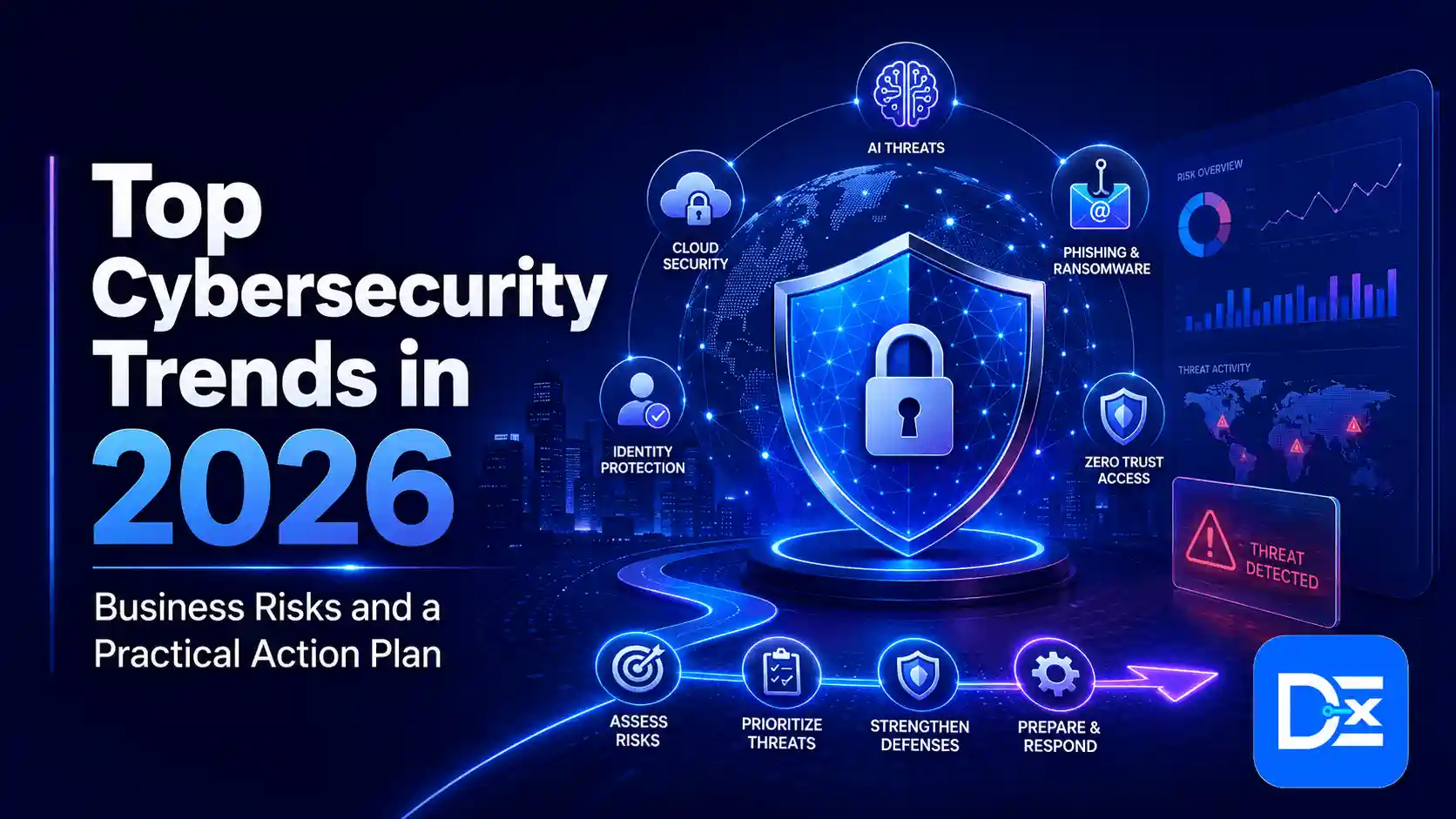
The most important cybersecurity trends in 2026 include:
- Faster exploitation of software vulnerabilities
- AI-powered phishing, deepfakes, and automated attacks
- Shadow AI and agentic AI security risks
- Identity-first and phishing-resistant authentication
- Data-focused ransomware and multi-extortion
- Converged cloud, container, and API security
- Supply-chain and third-party access attacks
- Secure-by-design software development
- Post-quantum cryptography preparation
- Stronger cybersecurity governance and regulatory accountability
Businesses should prioritize immediate risks such as vulnerable software, compromised identities, ransomware, and unauthorized AI use before investing heavily in longer-term initiatives such as post-quantum migration.
Cybersecurity Priorities for 2026 at a Glance
| Cybersecurity risk | Business impact | Priority | Recommended first step |
|---|---|---|---|
| Exploited software vulnerabilities | System compromise, downtime and data theft | Immediate | Identify internet-facing systems and patch actively exploited flaws |
| AI-powered social engineering | Fraud, credential theft and account takeover | Immediate | Introduce independent verification for sensitive requests |
| Weak identity controls | Unauthorized access and lateral movement | Immediate | Protect privileged accounts with phishing-resistant MFA |
| Ransomware and data extortion | Operational disruption, legal exposure and reputational damage | Immediate | Test isolated backups and incident-response procedures |
| Shadow AI | Data leakage, privacy violations and intellectual property exposure | High | Create an approved AI-use policy and tool inventory |
| Third-party access | Multi-company compromise and supply-chain disruption | High | Inventory vendors, integrations and service accounts |
| Cloud and API exposure | Data leaks and unauthorized application access | High | Inventory cloud assets, APIs, tokens and secrets |
| Agentic AI | Overprivileged autonomous actions | High | Assign an identity, owner and access policy to each agent |
| Regulatory changes | Fines, reporting failures and contractual risk | High | Map applicable regulations and reporting obligations |
| Quantum computing | Future exposure of long-lived encrypted data | Strategic | Build a cryptographic asset inventory |
Why 2026 Is a Turning Point for Business Cybersecurity
Three changes are reshaping cybersecurity.
First, attackers are operating faster. They can scan the internet, identify vulnerable systems, generate convincing phishing messages, analyze stolen data, and automate parts of an intrusion with AI.
Second, the traditional network perimeter has largely disappeared. Employees access company systems through cloud applications, home networks, mobile devices, APIs, browser sessions, and third-party platforms. A company may have strong office security while remaining exposed through an unmanaged SaaS account or forgotten vendor integration.
Third, cybersecurity is becoming a business governance issue. Customers, regulators, insurers, investors, and enterprise buyers increasingly expect organizations to demonstrate that risks are being identified, measured, and managed.
The NIST Cybersecurity Framework 2.0 reflects this shift. Its six core functions are Govern, Identify, Protect, Detect, Respond, and Recover. The addition of Govern places cybersecurity responsibilities, policies, oversight, and risk decisions at the organizational level rather than leaving them entirely with the IT department. 10 Cybersecurity Trends That Will Define 2026
1. Software Vulnerability Exploitation Is Becoming the Leading Entry Point
For years, stolen passwords and phishing were widely viewed as the primary ways attackers entered business systems. That balance is changing.
Verizon reports that 31% of breaches now begin with the exploitation of software vulnerabilities, making it the leading initial access method in its 2026 findings. oes not mean identity attacks are disappearing. It means businesses now face two urgent entry points at the same time: vulnerable technology and compromised users.
The business pain point
Many organizations receive thousands of vulnerability alerts but lack a reliable way to determine which issues should be fixed first. Security teams may spend time remediating high-scoring vulnerabilities that are difficult to exploit while overlooking flaws actively used by attackers.
Delayed patching becomes especially dangerous when the affected system is:
- Accessible from the internet
- Connected to sensitive data
- Used for remote access
- Integrated with identity systems
- Running on unsupported software
- Connected to other critical systems
The business solution
Move from periodic vulnerability scanning to continuous exposure management.
A practical process should follow five steps:
- Discover: Maintain an inventory of internet-facing systems, cloud assets, software, APIs and devices.
- Validate: Confirm whether a vulnerability is exploitable in your environment.
- Prioritize: Consider active exploitation, internet exposure, asset importance and attack paths.
- Remediate: Patch, isolate, reconfigure or remove the affected system.
- Verify: Confirm that remediation worked and the exposure is closed.
Use the CISA Known Exploited Vulnerabilities Catalog to identify vulnerabilities already associated with real-world exploitation. Teams can also use the Exploit Prediction Scoring System alongside CVSS to estimate exploitation probability rather than relying on severity scores alone.
How to measure progress
Track:
- Percentage of critical internet-facing assets inventoried
- Percentage of actively exploited vulnerabilities fixed within SLA
- Median time to remediate critical vulnerabilities
- Number of unsupported systems in production
- Number of reopened vulnerabilities after remediation
2. AI-Powered Social Engineering Will Target Business Processes
AI allows attackers to create polished phishing emails, realistic voice messages, synthetic video, fake documents and personalized scams at a much larger scale.
Verizon reports that 15% of attack techniques are now being strengthened by generative AI. It also found that mobile phishing can produce 40% higher click rates than traditional email phishing. atters because many companies have improved email filtering while leaving phone calls, messaging apps, SMS and video meetings dependent on human trust.
For a broader explanation of how attackers and defenders are using AI, read Digital Exclude’s guide to AI in cybersecurity.
The business pain point
Attackers do not need to defeat every security control. They only need to convince one employee to approve a request that appears legitimate.
Common targets include:
- Vendor bank-account changes
- Payroll-detail updates
- Password-reset requests
- Urgent executive payments
- Customer-data exports
- Privileged-access requests
- Confidential file transfers
- Software installation approvals
An employee may recognize a suspicious email but still trust a voice message that sounds like the CEO.
The business solution
Security awareness training should be supported by business-process controls.
Organizations should:
- Require independent verification for bank-detail changes
- Use known phone numbers instead of numbers supplied in a request
- Require two-person approval for high-value transactions
- Prevent help-desk teams from resetting privileged accounts based only on voice recognition
- Establish escalation procedures for unusual executive requests
- Train employees using realistic email, voice, SMS and collaboration-tool scenarios
- Use phishing-resistant authentication to reduce the value of stolen credentials
The goal is not to ask employees to identify every deepfake. The goal is to design processes that remain safe even when a message looks or sounds authentic.
How to measure progress
Track:
- Percentage of financial changes independently verified
- Number of authentication resets requiring escalation
- Simulation failure rates by communication channel
- Time taken to report suspicious messages
- Percentage of high-risk transactions using dual approval
3. Shadow AI and Agentic AI Will Create a New Access-Control Problem
Employees are adopting AI tools faster than many companies can govern them.
IBM found that 63% of organizations lacked policies to manage AI or prevent shadow AI. It also found that 97% of organizations reporting an AI-related security incident lacked appropriate AI access controls. AI includes unapproved chatbots, browser extensions, transcription tools, personal AI accounts, embedded SaaS features and employee-built automations. These tools may process customer information, source code, financial data, legal documents or internal strategy without proper oversight.
Agentic AI creates an additional risk. Unlike a basic chatbot, an AI agent may access applications, call APIs, retrieve data, change records and trigger business workflows. Digital Exclude’s comparison of an AI agent, chatbot and automation explains how these systems differ in autonomy and control.
The business pain point
Most identity and access-management systems were designed for people and conventional service accounts.
An AI agent may operate:
- Continuously
- Across several applications
- At machine speed
- With credentials inherited from a user
- Without a clear business owner
- Without detailed action logging
- With more access than its task requires
If the agent is manipulated through malicious instructions, insecure data or prompt injection, it may perform actions the business never intended.
The business solution
Create an AI-agent governance standard.
Every production AI agent should have:
- A unique machine identity
- A named business owner
- A documented purpose
- Approved data sources
- Least-privilege permissions
- Short-lived credentials where possible
- Complete activity logs
- Spending or transaction limits
- Human approval for high-impact actions
- A kill switch or rapid disablement process
- A scheduled access review
Businesses should also publish an acceptable-use policy explaining which AI tools employees may use and which data must never be entered into public systems.
Banning AI without providing approved alternatives often drives use underground. A better approach is to provide secure tools that solve the employee’s actual productivity need. Digital Exclude’s guide to AI automation for small businesses can help teams distinguish useful automation from unnecessary complexity.
How to measure progress
Track:
- Percentage of AI tools included in the approved inventory
- Percentage of AI agents with named owners
- Number of agents using shared credentials
- Percentage of agent permissions reviewed quarterly
- Number of shadow AI discoveries
- Number of high-risk agent actions requiring human approval
4. Identity Will Become the Primary Security Control Plane
Attackers increasingly use valid accounts, session tokens, OAuth permissions and service credentials instead of installing obvious malware.
Once an attacker controls a trusted identity, their activity may appear legitimate to traditional security tools. They can access cloud applications, reset passwords, create forwarding rules, approve integrations or move between systems using normal administrative functions.
The business pain point
Organizations often have:
- Shared administrator accounts
- Dormant employee accounts
- Excessive user privileges
- Long-lived API keys
- Unmonitored service accounts
- Weak account-recovery processes
- SMS-based authentication for sensitive systems
- Former vendors who still have access
These gaps expand the damage one compromised credential can cause.
The business solution
Adopt an identity-first security program.
Start with:
- Phishing-resistant MFA for administrators, finance staff and help-desk teams
- Passkeys or FIDO2 security keys where supported
- Individual accounts instead of shared logins
- Conditional access based on device, location and risk
- Just-in-time access for privileged roles
- Automatic removal of access when employees leave
- Quarterly reviews of privileged, dormant and vendor accounts
- Monitoring for unusual token use and privilege escalation
Digital Exclude’s guide to passkeys and passwordless authentication explains why passkeys provide stronger phishing resistance than reusable passwords.
How to measure progress
Track:
- Percentage of privileged accounts using phishing-resistant MFA
- Number of shared accounts
- Percentage of terminated-user access removed within the required timeframe
- Number of dormant accounts
- Number of permanent administrator assignments
- Percentage of service accounts with assigned owners
5. Ransomware Will Focus More Heavily on Data Extortion
Ransomware is no longer only an encryption problem.
Attackers may steal information before disrupting systems, then threaten to publish customer records, intellectual property, employee information or confidential communications. Some groups may skip encryption entirely if stolen data provides enough leverage.
Verizon reports that ransomware appears in 48% of breaches covered by its 2026 research. he business pain point
Many organizations believe backups provide complete ransomware protection. Backups can restore systems, but they cannot reverse:
- Stolen customer data
- Regulatory exposure
- Public data leaks
- Contractual violations
- Loss of intellectual property
- Damage to customer confidence
A company may restore its servers and still face a serious business crisis.
The business solution
Build resilience around both availability and confidentiality.
Organizations should:
- Maintain isolated or immutable backups
- Test restoration under realistic time pressure
- Segment critical systems
- Limit employee access to sensitive data
- Monitor unusual outbound data transfers
- Document credential-reset and token-revocation procedures
- Prepare legal, regulatory and customer-communication workflows
- Conduct ransomware tabletop exercises
- Identify which systems must be restored first
IBM recommends regularly testing incident-response plans and backups, defining clear responsibilities, and running crisis simulations rather than assuming documented plans will work during an emergency. ow to measure progress
Track:
- Backup-restoration success rate
- Time required to restore critical systems
- Mean time to contain an incident
- Percentage of sensitive data stores classified
- Percentage of critical systems segmented
- Number of unresolved tabletop-exercise findings
6. Cloud, Container and API Security Will Converge
Modern applications rarely operate inside a single server or network.
A customer-facing application may rely on cloud infrastructure, containers, serverless functions, APIs, databases, identity providers, third-party services and continuous deployment pipelines.
Treating each component as a separate security problem creates gaps between teams and tools.
Businesses still developing their cloud strategy can start with Digital Exclude’s 2026 cloud computing guide.
The business pain point
Common risks include:
- Publicly exposed cloud storage
- Excessive cloud permissions
- Forgotten development environments
- Unauthenticated APIs
- Hard-coded secrets
- Vulnerable container images
- Unrestricted service-to-service communication
- Incomplete logging
- Unmanaged SaaS integrations
An API may be technically functional while exposing more data than a user should be allowed to access.
The business solution
Create a unified cloud-native security process covering development and production.
Key controls include:
- Cloud asset and account inventory
- API inventory and ownership
- Infrastructure-as-code scanning
- Secret detection in repositories and pipelines
- Container image scanning
- Runtime workload monitoring
- Centralized cloud and identity logs
- Workload identities instead of embedded credentials
- API authentication and authorization testing
- Automated checks before deployment
How to measure progress
Track:
- Percentage of cloud accounts centrally monitored
- Percentage of APIs with assigned owners
- Number of public storage resources
- Number of exposed secrets
- Percentage of production workloads sending logs
- Percentage of container images scanned before release
7. Third-Party and Supply-Chain Access Will Remain a Major Business Risk
A company’s cybersecurity risk extends to every vendor, software provider, contractor, managed service provider and SaaS integration that can access its systems or data.
Third parties are attractive targets because one compromised provider may offer access to many customers.
The business pain point
Traditional vendor assessments often depend on questionnaires completed once a year. These documents may not reflect:
- Current access permissions
- Recent security incidents
- Newly added integrations
- Subcontractor dependencies
- Weak service accounts
- Optional MFA settings
- Expired contracts with active access
Businesses frequently know which vendors they pay, but not which vendors can access their systems.
The business solution
Move from questionnaire-based vendor management to access-based third-party risk management.
Organizations should:
- Inventory every vendor connection and integration
- Identify which suppliers access sensitive information
- Require MFA and individual vendor accounts
- Eliminate shared vendor credentials
- Limit access by system, role and time
- Include security and incident-notification requirements in contracts
- Review subcontractor and fourth-party dependencies
- Rotate credentials after a supplier incident
- Remove access when the relationship ends
- Test a third-party breach scenario
The NIST Cybersecurity Framework 2.0 specifically brings governance and supply-chain risk into the broader cybersecurity management process. ow to measure progress
Track:
- Percentage of critical vendors risk-assessed
- Percentage of vendor accounts protected by MFA
- Number of expired vendors with active access
- Percentage of contracts containing incident-notification requirements
- Time required to identify systems connected to a breached supplier
- Percentage of critical vendors reviewed quarterly
8. Secure-by-Design Development Will Become a Commercial Requirement
Security defects become more expensive to correct after software reaches production.
Secure-by-design development treats authentication, access control, logging, encryption, safe defaults and recovery as product requirements from the beginning.
This is becoming more than an engineering best practice. Customers and regulators increasingly expect software manufacturers to take responsibility for product security.
The business pain point
Development teams are often measured primarily on release speed. Security reviews happen late, when major architectural changes are expensive and deadlines are difficult to move.
This produces:
- Weak default configurations
- Insecure administrative features
- Excessive data collection
- Missing audit logs
- Unsupported dependencies
- Hard-coded secrets
- Unclear vulnerability-disclosure processes
- Security updates that are difficult to deploy
The business solution
Integrate security into the software development lifecycle.
A practical secure development program should include:
- Threat modeling for important features
- Security acceptance criteria
- Code and dependency scanning
- Secret scanning
- Peer review for sensitive functions
- Automated testing in CI/CD pipelines
- Software bills of materials where appropriate
- Coordinated vulnerability disclosure
- Documented support and update periods
- Safe default configurations
- Post-release monitoring
The CISA Secure by Design initiative encourages software manufacturers to treat customer security as a core product requirement rather than shifting the burden to users.
How to measure progress
Track:
- Percentage of high-risk features threat-modeled
- Percentage of repositories using automated security checks
- Number of critical defects discovered after release
- Time required to fix reported vulnerabilities
- Percentage of products with documented support periods
- Percentage of products using secure defaults
9. Post-Quantum Security Planning Must Begin Before Quantum Attacks Arrive
Quantum computers capable of breaking modern public-key cryptography are not currently available. However, replacing cryptography across enterprise systems can take years.
The risk is especially important for data that must remain confidential for a long time. Attackers may collect encrypted information today and attempt to decrypt it later when more capable quantum technology becomes available.
In August 2024, NIST finalized its first three post-quantum cryptography standards. NIST stated that the standards are ready for immediate use and encouraged system administrators to begin transitioning as soon as possible. he business pain point
Cryptography is embedded throughout:
- Websites and applications
- VPNs
- Email systems
- Certificates
- APIs
- Cloud platforms
- Identity systems
- Mobile applications
- Databases
- IoT and embedded devices
- Vendor products
Many organizations do not know where cryptographic algorithms are used or how easily they can be replaced.
The business solution
Do not begin by replacing every algorithm immediately. Begin with discovery and crypto agility.
Organizations should:
- Create an inventory of cryptographic assets.
- Identify data requiring long-term confidentiality.
- Document systems using RSA, ECC and other affected algorithms.
- Ask critical vendors for post-quantum roadmaps.
- Include crypto-agility requirements in new procurement.
- Test migration in controlled environments.
- Prioritize systems with long replacement cycles.
How to measure progress
Track:
- Percentage of cryptographic assets inventoried
- Percentage of critical vendors with documented migration plans
- Number of systems unable to change cryptographic algorithms
- Percentage of long-lived sensitive data assessed
- Number of post-quantum migration tests completed
10. Cybersecurity Governance and Regulatory Accountability Will Expand
Cybersecurity is moving from the server room to the boardroom.
Executives are increasingly expected to understand the organization’s cyber risks, approve priorities, monitor resilience, and ensure that incidents are reported appropriately.
In the European Union, the NIS2 Directive establishes cybersecurity requirements across 18 critical sectors. It introduces risk-management and incident-reporting obligations and places accountability for noncompliance with cybersecurity measures on top management. U Cyber Resilience Act] also introduces lifecycle security obligations for products with digital elements. Its reporting obligations begin on September 11, 2026, while its main obligations apply from December 11, 2027. he business pain point
Organizations often report activity rather than outcomes.
A board may hear that:
- Thousands of vulnerabilities were scanned
- Employees completed training
- New security tools were installed
- Policies were updated
These facts do not show whether business risk has decreased.
The business solution
Connect cybersecurity reporting to business impact.
Leadership reporting should answer:
- Which business services are most exposed?
- What could interrupt revenue or customer delivery?
- Which high-risk findings remain unresolved?
- How quickly can critical operations be restored?
- Which suppliers create concentration risk?
- Are regulatory reporting deadlines understood?
- Who accepts the remaining risk?
Cybersecurity governance should establish clear ownership across IT, security, legal, finance, procurement, HR, product development and executive leadership.
How to measure progress
Track:
- Mean time to detect, contain and recover
- Percentage of critical risks with named owners
- Percentage of overdue high-risk remediation actions
- Backup-restoration success rate
- Percentage of critical vendors reviewed
- Percentage of privileged accounts using strong authentication
- Percentage of applicable regulatory obligations mapped to controls
A Practical 30, 90 and 365-Day Cybersecurity Roadmap
Businesses do not need to implement every technology at once. They need to address the risks that create the greatest potential damage.
What to Do in the First 30 Days
Focus on visibility and immediate exposure reduction.
- Identify critical business systems and sensitive data
- Inventory internet-facing systems
- Patch actively exploited vulnerabilities
- Enforce MFA for administrators, finance and remote access
- Review privileged and dormant accounts
- Confirm backups are isolated from production
- Test restoration for one critical system
- Inventory important vendors and SaaS integrations
- Identify employees using unapproved AI tools
- Confirm incident contacts and escalation procedures
What to Do in Days 31 to 90
Build repeatable controls.
- Introduce phishing-resistant authentication for high-risk roles
- Review OAuth applications, API tokens and service accounts
- Create an approved AI-use policy
- Establish an AI-agent inventory
- Centralize identity, cloud and endpoint logs
- Define vulnerability-remediation SLAs
- Run a ransomware or supplier-breach tabletop exercise
- Review vendor incident-notification clauses
- Classify critical data stores
- Create basic security KPIs for leadership
What to Do in Months 4 to 12
Develop long-term resilience.
- Implement identity threat detection
- Formalize continuous exposure management
- Improve cloud and network segmentation
- Integrate security testing into CI/CD pipelines
- Build a cryptographic asset inventory
- Establish recurring third-party access reviews
- Test customer and regulatory communication procedures
- Create current and target NIST CSF profiles
- Review AI-agent permissions quarterly
- Present cybersecurity performance to senior leadership
Cybersecurity Priorities by Business Size
Small Businesses
Small businesses should prioritize controls that reduce the most common and damaging risks without creating unnecessary complexity.
Focus on:
- MFA and passkeys
- Managed endpoint protection
- Automatic software updates
- Cloud backups
- Password management
- Email and mobile phishing protection
- Payment-verification procedures
- Managed detection and response where internal expertise is limited
Small teams should also review Digital Exclude’s guide to cybersecurity threats in 2026 for additional everyday protection measures.
Mid-Sized Businesses
Mid-sized organizations need more centralized visibility and formal processes.
Focus on:
- Centralized identity management
- Cloud-security monitoring
- Identity threat detection
- Vendor-access reviews
- Security logging and alert correlation
- Network segmentation
- Incident-response exercises
- Formal AI governance
- Secure software development practices
Large Enterprises and Regulated Organizations
Large organizations should manage cybersecurity as an enterprise-risk program.
Focus on:
- Continuous exposure management
- AI-agent and non-human identity governance
- Security automation with human oversight
- Advanced supply-chain assurance
- Operational technology security
- Post-quantum migration planning
- Regulatory mapping
- Board-level risk reporting
- Cross-functional crisis management
Common Cybersecurity Mistakes Businesses Should Avoid in 2026
Buying More Tools Without Fixing Governance
Disconnected security products can increase cost and alert volume without reducing risk. Businesses should first clarify ownership, processes, data flows and response procedures.
Treating Annual Training as the Main Human Defense
Training is useful, but employees should not be expected to identify every sophisticated scam. Verification procedures and approval controls provide stronger protection.
Assuming MFA Solves Every Identity Risk
Some MFA methods can still be phished or bypassed. Privileged and high-risk accounts should use phishing-resistant methods such as passkeys or hardware security keys.
Assuming Backups Solve Ransomware
Backups support recovery, but they do not prevent data theft, regulatory exposure or reputational damage.
Banning AI Without Providing Approved Alternatives
Employees may continue using AI through personal accounts if approved tools do not meet their needs. Businesses should combine policy, secure alternatives, access controls and monitoring.
Treating Compliance as Proof of Security
Compliance establishes minimum requirements. It does not guarantee that controls are effective against current threats.
Frequently Asked Questions
What is the biggest cybersecurity trend in 2026?
The biggest trend is the increasing speed and automation of attacks. AI is helping attackers identify vulnerabilities, personalize social engineering and process stolen information more efficiently. At the same time, software vulnerabilities have become the leading initial breach vector in Verizon’s 2026 findings.
How is AI changing cybersecurity in 2026?
AI is helping defenders analyze alerts, detect unusual behavior and automate initial response. It is also helping attackers create phishing content, research vulnerabilities and scale fraud. Businesses need both AI-enabled security and strong governance for employee tools, models and autonomous agents.
What should small businesses prioritize first?
Small businesses should prioritize software updates, MFA, passkeys, reliable backups, endpoint protection, payment-verification procedures and access removal when employees leave.
Is zero trust still relevant in 2026?
Yes. Zero trust remains relevant because users, devices, applications and agents cannot be trusted solely because they are inside a company network. In practice, zero trust means continuous verification, least-privilege access and monitoring of identities and devices.
Should businesses prepare for quantum computing now?
Businesses do not need to replace every encryption system immediately. They should begin by identifying where cryptography is used, determining which data requires long-term protection and ensuring future systems can change algorithms without complete replacement.
What cybersecurity metrics should executives monitor?
Executives should monitor remediation time, privileged-account protection, backup-restoration success, incident containment time, high-risk vendor exposure, overdue critical findings and the percentage of important risks with named owners.
Final Thoughts
The most important lesson from the cybersecurity trends of 2026 is that businesses must move from reactive protection to measurable resilience.
AI, cloud platforms, autonomous agents, APIs, third-party services and connected devices are creating valuable business opportunities. They are also introducing identities, permissions, data flows and dependencies that traditional security programs were not designed to manage.
The answer is not to stop innovation or purchase every new security product. It is to build a disciplined cybersecurity program around a few practical principles:
- Know which systems, identities, data and vendors matter most.
- Fix exposures based on real business risk.
- Verify sensitive actions instead of relying on trust.
- Limit access for people, applications and AI agents.
- Practice containment and recovery before an incident occurs.
- Measure whether controls are producing better outcomes.
- Make cybersecurity accountability part of business leadership.
Organizations that follow these principles will not eliminate every cyber risk. They will be better prepared to prevent avoidable incidents, limit the damage of successful attacks, recover critical operations and continue serving customers when disruption occurs.
For more practical security guidance, explore the latest articles in Digital Exclude’s Cybersecurity section.